

11 min 44 sec
Available in: English
Joy Inc.: How We Built a Workplace People Love
Shows how a software company made joy the base of its culture, using open rooms, paired work, daily rituals, team-run hiring and a safe place to fail, so people work harder and try bolder ideas.
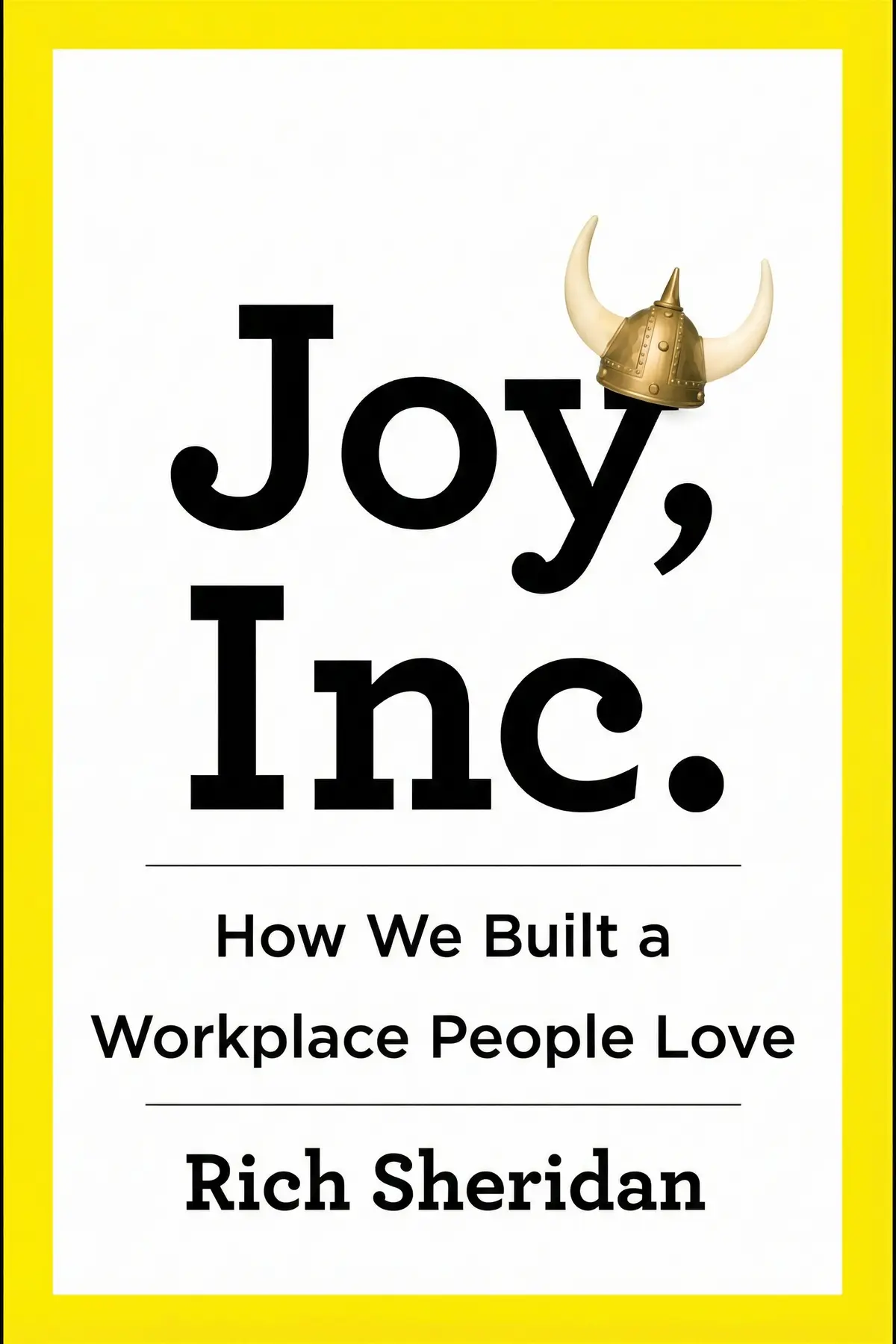
Table of Content
1. Introduction
56 sec
Most people save their joy for the weekend and treat work as the price they pay for it. Rich Sheridan argues that this split is a costly mistake, because joyful people work longer and harder and pull together toward something bigger than themselves. In Joy Inc., he shows how his software company, Menlo Innovations, turned that belief into daily practice.
His case is that joy is something a company can design, not something it has to wait for. It comes from the room people sit in, the way they talk, the habits they share, the people they hire and the freedom they have to fail. Each of those is a choice a leader or a team can make on purpose.
The examples are vivid: a Viking helmet passed around a morning meeting, an afternoon walk for the whole staff, and a newborn who came to the office every day. Each points to a change you could test with your own team within weeks.
2. Make joy the reason people give their best
1 min 31 sec
Two rivals raced to build the first airplane, and only one of them won. Sheridan believes their motives explain the result, and he uses a single question to show clients what that means for their own projects.
3. Rearrange the room to change how people think
1 min 36 sec
A gray office of fixed cubicles sends a message before anyone speaks. Menlo built a space that its staff can reshape at will, and Sheridan links that freedom to the moment a stuck problem finally gives way.
4. Talk in person to end workplace conflict
1 min 40 sec
Many office feuds begin with a message that was never meant to sound cold. Menlo gave direct conversation a playful technical name and then built its whole way of working around two people and one keyboard.
5. Give your team rituals that show what you value
1 min 36 sec
A horned helmet, an afternoon stroll and a client asked to explain the work back to the team. Each looks like a quirk, yet together they keep a whole company aligned and cut the confusion that starts arguments.
6. Hire for attitude and let your team decide
1 min 38 sec
Menlo will turn away a brilliant engineer who prefers to work alone. Its unusual group interview tests a skill most people last practiced at age five, and the final verdict belongs to the staff, not the boss.
7. Feel safe at work and try bolder ideas
1 min 36 sec
A newborn in a software office became an unexpected selling point. A giant project that nobody dared to stop became a very expensive lesson. Both stories turn on the same question: what happens when people stop fearing failure?
8. Conclusion
1 min 11 sec
Joy Inc. treats the feeling people have at work as something to build, as concrete as wiring and furniture. Menlo’s tools are ordinary: an open room that can be rearranged in an afternoon, two people sharing one computer, a helmet passed around at ten, a walk at three, a wall that shows who owns each task, an interview where strangers must work together, and a culture where failure goes unpunished. None of it costs much. All of it tells people that they belong and that their work matters beyond one desk.
The book supports a few moves you can make soon. Open up your space, even a little, and let the team decide how to arrange it, since taking down physical walls tends to take down the ones that block ideas. Settle tense threads in person instead of by email. Choose one ritual that says what your team values and keep it every day. And when a project is clearly failing, let it fail early.
In Sheridan’s telling, the Wright brothers beat a rival chasing fame because they were chasing the joy of flight. A workplace can be built to give people that same reason to try.
About this book
What is this book about?
Most workplaces treat joy as something people find on weekends. Rich Sheridan disagrees. In his view, joyful people put in more effort and more hours, and they pull together toward goals larger than themselves. That makes joy a business advantage, and something a leader can build on purpose. Sheridan tells the story through Menlo Innovations, his software company. Its offices are one open room with furniture light enough to move in an afternoon. Every task is done by two people sharing one computer, and the pairs change each week. A horned Viking helmet goes around the daily standup, the whole staff walks together at three, and a wall board shows who owns each task. Candidates are hired in group interviews where staff judge how well they work with others, and failure brings no criticism. One result was an employee's baby coming to the office every day. Readers get a set of concrete practices for any team that wants less conflict and more energy: rearrange the space, settle tension face to face, choose rituals that carry your values, hire for attitude, and let weak projects fail early instead of draining money for years.
Book Information
Who it's for
Leading frustrated teams
Team leads and managers whose teams argue over email and dread Monday meetings.
Founders building from scratch
Founders designing an office, a hiring process or a culture from scratch.
Wanting more energizing work
Professionals who want ideas to make their own corner of work more energizing.
About the Author
Rich Sheridan
Rich Sheridan started programming as a child in 1971. He earned a bachelor's degree in computer science from the University of Michigan in 1980 and a master's in computer engineering in 1982, and he was the subject of a Forbes cover story in 2003. His work centers on process, teamwork, organizational design and the business value of joy. His team at Menlo Innovations modeled its culture on Thomas Edison's Menlo Park laboratory, and the company has won five Inc. magazine revenue growth awards.
Ratings & Reviews
Ratings at a glance

What people think
Listeners find this to be a wonderful work that brings happiness to the office and is filled with real-world applications. They value the motivating material, as one listener points out that it triggers meaningful discussions inside their organization. The book is praised for being imaginative within an inventive setting, while one listener highlights how it encourages original thinking. Listeners prize its new outlook on employment, with one characterizing it as a total transformation of their professional surroundings.
Top reviews
Mint
Finally got around to reading Joy Inc., and it feels like a total overhaul of everything I thought I knew about professional culture. Sheridan provides a blueprint for an environment where human dignity isn't just a buzzword but the actual engine of production. I loved the practical stories about 'High-Speed Voice Technology'—which is really just talking to each other—and the radical idea of bringing infants into the office to support parents. It is a bit idealistic, and I do wonder if these methods truly scale to massive, global corporations, but the inspiration alone is worth the price of admission. My leadership team has already started implementing the 'visual management' boards he describes to track our progress. It has sparked some genuinely deep conversations about why we do what we do every day. Fantastic read!
Show moreGift
The chapter on ethnographic research and 'High-Tech Anthropologists' was a total game-changer for my perspective on product design. Sheridan doesn't just talk about being happy; he talks about building things that actually matter to the people who use them. This isn't just another dry management manual; it's a creative manifesto for building a workplace that people actually want to show up to. Not gonna lie, the idea of no more 'emergency' weekend emails sounds like a dream I’m ready to wake up in. It’s packed with innovation-driving tactics that any manager could adapt, regardless of their industry. I’ve already bought copies for my entire executive board to read because it prompts such deep internal reflection.
Show moreMattanee
Wow. This book is a complete overhaul of the traditional corporate mindset. I finished it in two sittings and immediately started rethinking our entire onboarding process. The concept of 'joy' as a business result is so simple, yet so revolutionary when you see how Sheridan implements it through pairing and open communication. It’s not just about beanbags and free snacks; it’s about the fundamental way human beings interact with their labor and each other. Personally, I found the stories about parents bringing their kids to work moving, even if it seems impractical for my specific office. It’s a fantastic, heart-centered approach to business that we desperately need more of in today's cutthroat world.
Show moreEleni
Truth is, I was skeptical that a book with 'Joy' in the title would have any real substance, but I was pleasantly surprised. This is a practical, step-by-step look at how to build a culture of discipline and delight. Sheridan’s writing style is accessible and engaging, making complex project management concepts feel like common sense. I was particularly impressed by the 'Pairing' system—not just for coding, but for cross-training and eliminating the risk of one person holding all the knowledge. It’s an inspirational read that prompts deep reflection on what we should expect from our employers. It’s easily one of the most creative business books I’ve read in years, delivering a fresh perspective on what 'work' can be.
Show moreBun
As a software engineer who has dealt with my fair share of burnout, this was a breath of fresh air. The focus on pair programming and eliminating the 'fear of failure' resonates deeply with anyone who has ever stared at a bug for eight hours alone. To be fair, some of the rigid structure feels a bit like an assembly line, which the author even admits to by using the factory metaphor. That might rub some 'rockstar' developers the wrong way because they lose that sense of individual ownership. I also wish there was more about how this works in a post-pandemic, remote-first world since Sheridan is quite anti-WFH. Regardless, the creativity it fosters is undeniable and the book is packed with practical examples for team building.
Show moreUbolrat
Ever wonder if there’s a way to work that doesn’t leave you feeling hollow by Friday afternoon? Joy Inc. argues that intentional culture is the answer, and Sheridan backs it up with tons of tactical examples from his own firm. I was particularly struck by the 'Show and Tell' sessions which seem to bridge the gap between developers and clients perfectly. Look, I’m not sure I’m ready to sit next to the CEO every day or share a computer with a partner, but the spirit of the book is infectious. It challenges the 'hero' culture that plagues tech and replaces it with collaborative innovation. A few parts felt a little repetitive, but the core message is vital for any growing business.
Show moreRin
After hearing Rich speak at a conference, I had to dive into the full story of Menlo Innovations. The book is an excellent deep-dive into how they use physical space and social contracts to eliminate the silos that usually kill productivity. I love the focus on 'making mistakes early' to keep costs down and morale high. My only real gripe is that it feels a bit dated regarding remote work; the author is very insistent that you have to be in the same room to be effective. In today’s world, that’s a tough pill to swallow for many top-tier talents. However, the principles of accountability and empathy are still incredibly relevant and worth studying for any leader.
Show moreLuckana
Picked this up because our company is going through a massive transition and we needed a fresh perspective on team structure. While I don't think we can replicate the Menlo model exactly—the noise levels alone would be a huge adjustment for us—there are so many 'nuggets' of wisdom here. The way they handle 'estimating' work using physical cards is a brilliant way to make abstract concepts tangible for clients. It’s an analytical look at how human psychology drives production. I did find the author's tone a bit self-congratulatory at times, but the results he’s achieved are hard to argue with. Definitely a must-read for anyone interested in Agile or lean management.
Show moreRodrigo
To be fair, Sheridan has clearly built something unique at Menlo, but I struggled with how applicable this is outside of a small software shop. The 'factory' metaphor he uses is quite telling—he values process and predictability over individual autonomy. While the book is full of joy-focused rhetoric, the actual day-to-day sounds incredibly noisy and socially draining for many personality types. I appreciate the transparency about their experiments, but the lack of discussion on cultural diversity made the team feel a bit monolithic. It’s a decent read for the 'Agile' crowd, but take the universal claims with a grain of salt. It is hard to see this working in healthcare or manufacturing without a massive rethink.
Show moreSomporn
Not what I expected at all. In my experience, a workplace that claims to be a 'joyful factory' is usually anything but. The book reads more like a massive PR brochure for Menlo Innovations rather than a balanced guide on leadership or transformation. While the concept of joy is great, the implementation sounds like a total nightmare for anyone who needs a quiet space to concentrate. Imagine trying to code while your coworker’s baby is crying or while someone is constantly talking over your shoulder in a forced pair. Sheridan seems a bit too enamored with his own systems to acknowledge that this 'nirvana' might be hell for introverts. It’s an interesting experiment, but the 'one right way' attitude feels very out of touch with modern professional needs.
Show moreQuestions about this book
What is the main idea of Joy Inc. by Rich Sheridan?
Sheridan argues that joy is a business advantage a company can design. Joyful people, he says, work longer and harder and feel part of something larger than themselves. At his software company, Menlo Innovations, joy is built through an open, movable office, direct conversation, paired work, daily rituals, hiring for attitude and a culture where failure is not criticized, which he links to higher productivity and more innovation.
What is high-speed voice technology at Menlo Innovations?
It is Menlo’s playful name for talking to people directly instead of through email or a go-between. In the open office, anyone can overhear a discussion and join it. Sheridan says face-to-face talk lets people read body language, avoids passive-aggressive misunderstandings and builds relationships. Pairing two people on one computer, with partners reshuffled weekly, makes this kind of communication part of every task.
How does Menlo Innovations hire people?
Menlo hires mainly for personality and openness to joy, with skills second. Candidates tour the open office, then attend an extreme interview with many applicants at once. They work in pairs while a Menlo employee observes, three times with different partners and observers, to test their kindergarten skills, the ability to play well with others. Afterward the employees evaluate the candidates together.
How can I apply Joy Inc. to my own team?
Start small. Let your team rearrange its space, or move a meeting somewhere new. When an email thread turns tense, go and talk in person. Add a light daily ritual, such as a short standup or a shared walk, and make it visible who owns which task. In hiring, include a paired exercise and ask your team for their judgment. When a project is failing, stop it early.
Who should read Joy Inc.?
It suits managers, team leads and founders who want a workplace with less conflict and more energy, and who prefer concrete practices to slogans. Its examples, from a Viking helmet at the morning standup to a newborn in the office, come from one software company, Menlo Innovations, but the ideas about space, communication, rituals, hiring and safety apply to many kinds of teams.
Featured in
Readers also enjoyed

A Bigger Prize: How We Can Do Better Than the Competition
Margaret Heffernan





A Year with Peter Drucker: 52 Weeks of Coaching for Leadership Effectiveness
Joseph A. Maciariello



AUDIO SUMMARY AVAILABLE
Listen to Joy Inc. in 15 minutes
Get the key ideas from Joy Inc. by Rich Sheridan, plus 5,000+ more nonfiction titles.
- 5,000+ titles
- Listen as much as you want
- 7-day free trial
- Cancel anytime









