
15 min 34 sec
Available in: English
How to Create a Mind: The Secret of Human Thought Revealed
By Ray Kurzweil
Ray Kurzweil explains how the brain's neocortex turns layered pattern recognition into memory, emotion and creativity, and why he expects machines built on the same principle to think and become ordinary by the 2030s.
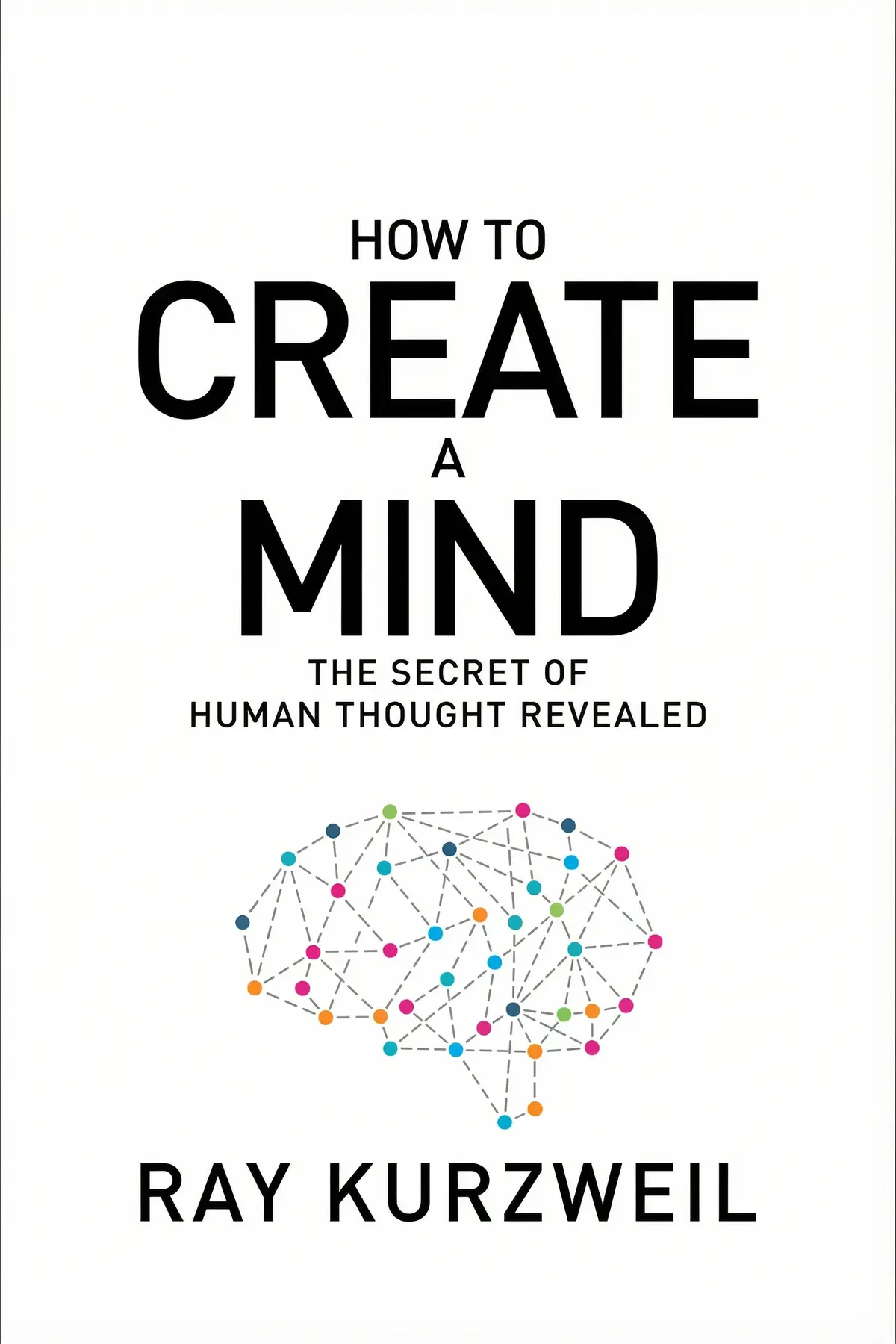
Table of Content
1. Introduction
1 min 01 sec
If artificial intelligence feels like a black box, and your own mind feels like a deeper one, Ray Kurzweil offers one simple picture of both. In How to Create a Mind, the inventor and futurist argues that thinking comes down to a single repeated trick: recognizing patterns, arranged in layers, some 300 million times over in the brain’s neocortex. That is why a familiar smell can bring back a whole afternoon from childhood, and why saying the alphabet backwards feels strangely hard.
His argument is bold. If the mind is a hierarchy of pattern recognizers, it can be described in a few pages, and what can be described that clearly can be built. Kurzweil follows that logic from brushing your teeth to Siri, from IBM’s Watson on a quiz show to a forecast of convincing machine minds by 2029. Expect a working model of your own memory and a clear view of the machines designed to copy it.
2. Recover a whole memory from one small cue
1 min 40 sec
A forgotten afternoon can return in full from a single smell, yet the alphabet you know perfectly becomes a struggle the moment you reverse it. Both puzzles point to the same rule about how memories are filed.
3. Your thinking runs on patterns inside patterns
1 min 53 sec
Brushing your teeth looks like one simple act. Kurzweil sees in it the blueprint for how 300 million tiny units in your brain read words, recognize objects and guess at things they have never seen.
4. The brain parts that decide what you remember
1 min 48 sec
The neocortex gets the credit for thought, but three smaller structures shape what it feels, what it keeps and how gracefully you move. One of them is the reason you notice a friend’s new haircut.
5. Understand anger, love, and creativity through the neocortex
2 min 00 sec
Anger and passion push people into choices they later regret, and the cause lies in a special kind of brain cell. The same machinery also explains where metaphors come from and how to have more of them.
6. Learn how software teaches itself like a child
1 min 57 sec
For decades, building a mind meant hand-feeding a machine more information than anyone could supply. A probability method from the 1980s changed that, and a version of it now answers questions on millions of phones.
7. Decide for yourself whether a machine can think
1 min 59 sec
A computer read 200 million pages and beat champions on a pun-filled quiz show. Kurzweil makes a claim about what it was doing that many people would resist, and the science of free will complicates the argument.
8. A timeline for thinking machines you can check
1 min 58 sec
Kurzweil names a year for convincing machine minds and backs it with chip designs, memory sums and his own forecasting record. The numbers are specific enough that you can test them yourself.
9. Conclusion
1 min 18 sec
Open up a computer and the tangle of parts looks hopeless. Step back, though, and its workings fit into a few pages of text and some formulas. Kurzweil’s wager is that the brain allows the same step back. Beneath the smell that revives a childhood afternoon, the haircut you noticed and the poem that moves you lies one repeated unit, a small pattern recognizer, layered about 300 million times. Describe it clearly enough and it can be built, which is why he treats Siri and Watson as early drafts.
The model is useful long before any machine catches up. When a memory will not come, reach for one fragment, a face, a smell, the first line, and let the sequence unroll. When anger floods in, remember that spindle cells are louder than reason for a while, and wait before deciding. When a creative problem stalls, add a second mind. And when the next AI headline arrives, ask whether the system learns patterns in layers, the way your neocortex has all your life.
The mind may be the most complicated thing we know, yet in Kurzweil’s view it is no mystery, and that is what makes it possible to copy.
About this book
What is this book about?
A familiar smell can bring back a moment from years ago, yet the alphabet becomes hard the instant you say it backwards. Ray Kurzweil, an inventor and futurist, treats small puzzles like these as clues to how the mind is built. His answer is that the neocortex, the brain's outer layer, runs on about 300 million pattern recognizers arranged in layers, each passing what it detects to the one above. From that model he explains how memories are stored in order, how the thalamus, hippocampus and cerebellum support the neocortex, why spindle cells make anger so hard to control, and where metaphor and creativity come from. Then he turns the model into an engineering plan. Software built on the hierarchical hidden Markov model already learns by recognizing patterns, from voice recognition to Siri, and IBM's Watson beat top Jeopardy! players by weighing likely answers. Kurzweil argues that such machines already think. Using his law of accelerating returns, he predicts convincing AI by 2029 and everyday AI in the 2030s. Readers get a clear model of their own minds and a specific forecast they can test.
Book Information
Who it's for
Professionals using AI daily
Professionals who use AI tools daily and want to understand the brain-inspired idea behind them.
Students and curious minds
Students and curious readers who wonder why memories return from a single smell or song.
Wanting a testable forecast
Founders and planners who want a specific, testable forecast of when thinking machines arrive.
About the Author
Ray Kurzweil
Ray Kurzweil is a computer scientist, inventor, entrepreneur and futurist, born in Queens, New York, in 1948. His work has shaped optical character recognition, text-to-speech synthesis, speech recognition and electronic keyboard instruments. He received the National Medal of Technology and Innovation in 1999, entered the National Inventors Hall of Fame in 2002 and won a Grammy Award for achievement in music technology. He writes on artificial intelligence, health technology, transhumanism and the technological singularity, and his books include The Singularity Is Near, The Age of Spiritual Machines and The Singularity Is Nearer.
Ratings & Reviews
Ratings at a glance
What people think
Listeners find the writing accessible and polished, with one listener observing that it is approachable for a persistent and educated reader. This work provides a great introduction to brain function; one listener describes it as the first comprehensive general theory of brain/mind, while another points to the detailed exploration of memory processes. Listeners appreciate the thought-provoking material, with one listener highlighting the enjoyable philosophical discussions and thought experiments, and they find the vision for the future to be fascinating. Although many feel the explanations are clear, some find them highly confusing.
Top reviews
Manee
This book is probably the most accessible introduction to the "Pattern Recognition Theory of Mind" I’ve encountered. Kurzweil explains the modular nature of the neocortex with such clarity that even a layperson can grasp how we process complex hierarchies. I was particularly fascinated by his breakdown of memory—not as a simple recording, but as a series of redundant patterns. While he does spend a fair amount of time on his own inventions, his track record in OCR and speech recognition gives him the authority to speak on these architectures. The later chapters on consciousness and the "Chinese Room" experiment provided exactly the kind of philosophical depth I was hoping for. It’s a bold vision for the future of AI that feels grounded in biological reality rather than pure science fiction. Truly a must-read for anyone curious about the intersection of neuroscience and computing.
Show moreAmara
As someone who has always been intimidated by neuroscience, I found Kurzweil's writing style incredibly refreshing and easy to digest. He has a gift for taking dense concepts—like how the brain uses recursion to build complex ideas—and making them feel intuitive. The way he describes the neocortex as a blank slate that learns through experience changed how I think about human potential. I especially enjoyed the thought experiments regarding identity and whether a digital copy of a brain would still be "you." Some critics call his predictions overly optimistic, but the data he presents on the exponential growth of computing power is hard to argue with. This isn't just a book about machines; it's a profound look at what makes us human. It's the kind of reading that sticks with you long after you've put it down.
Show moreScarlett
Wow. This is easily one of the most provocative books I’ve read in years. Kurzweil doesn’t just explain how the brain works; he explains how we can transcend its biological limitations. His theory that the neocortex is essentially a giant array of 300 million pattern recognizers is elegantly simple and powerful. I loved the section on "Qualia" and the deep dive into whether a computer could ever truly "feel" something. It’s rare to find a book that handles technical details and existential philosophy with equal skill. While some people find his self-referential style annoying, I think it adds a layer of authenticity to the narrative—he’s not just theorizing; he’s been in the trenches building this stuff for fifty years. If you’re interested in where humanity is going, you need to read this book.
Show moreCamila
Finally got around to reading this, and it’s a brilliant synthesis of computer science and biology. Kurzweil’s vision of a software-based neocortex that can be expanded in the cloud is both terrifying and exhilarating. The book is incredibly readable for such a complex subject; he manages to explain the "redundant hierarchy" of our thoughts without getting bogged down in unnecessary jargon. I particularly appreciated his response to critics in the final chapters, as it clarified a lot of the common misunderstandings about his timelines. It’s a comprehensive general theory of the mind that feels like it’s finally catching up to the reality of 21st-century technology. Whether you agree with his conclusions or not, you can’t deny that his insights into pattern recognition are fundamental to our understanding of intelligence.
Show moreSawit
Ever wonder how 300 million pattern recognizers in your head actually produce a personality? Kurzweil attempts to answer this by bridging the gap between biological neurons and computer algorithms. He relies heavily on the Hierarchical Hidden Markov Model (HHMM) to explain our cognitive processes, which might feel repetitive if you're already familiar with his work. To be fair, he acknowledges that some of these ideas parallel Jeff Hawkins’ earlier theories, but Kurzweil adds his own "Law of Accelerating Returns" flavor to the mix. The writing is smooth and readable, though I'll admit the middle section drags a bit when he dives into the specific math of speech recognition. It’s not a perfect manual for building a robot, but it’s a brilliant conceptual framework. I walked away with a much better understanding of how my own brain predicts the next word in a sentence.
Show moreHazel
Picked this up because I wanted to understand the logic behind Google’s current AI direction, and Kurzweil delivers a solid foundation. His explanation of the "redundancy" in our neural circuits explains so much about why we are able to recognize a face even in bad lighting or at an odd angle. The book is well-written and maintains a steady pace, even when the topics get a bit "geeky" regarding digital Neocortex simulations. I did find the sections on free will and Wolfram’s cellular automata to be a little out of left field, but they were still entertaining. My only real gripe is that he glosses over some of the massive hurdles in knowledge representation that we still haven't solved. Still, for a high-level overview of where we are headed, it's a fascinating and largely convincing piece of work.
Show moreRapee
After hearing so much about the "Singularity," I wanted to see if the science actually backed up the claims. Kurzweil provides a compelling argument for the "Law of Accelerating Returns," showing how biological evolution is being superseded by technological evolution. He breaks down the brain's architecture into manageable chunks, explaining how simple patterns build into the vast complexity of human thought. The discussion on Watson's Jeopardy victory was a highlight for me; it made the abstract concepts feel very real and current. Look, he’s definitely a "big picture" guy, so don't expect a step-by-step coding tutorial. However, if you want to understand the philosophical implications of artificial general intelligence, this is an excellent starting point. It’s dense in parts but ultimately rewards the persistent reader with a very unique perspective on the future.
Show moreMaksim
The chapter on the "old brain" versus the neocortex was genuinely illuminating, but the rest of the book feels like a mixed bag. On one hand, Kurzweil is a visionary who describes the future of machine intelligence with infectious enthusiasm. On the other hand, there is an exhausting amount of self-promotion that borders on a marketing brochure for his previous companies. Frankly, I didn't need a ten-page defense of why he was right and Paul Allen was wrong about the "singularity." The transition from hard science to philosophical discussions in the final third felt disjointed, as if the book couldn't decide if it wanted to be a textbook or a memoir. If you can filter out the ego, there are some great insights here regarding how AI like Watson actually functions. It's just a shame you have to dig through so much fluff to find them.
Show moreTang
Technically impressive but emotionally cold. The first half of the book is a great introduction to the brain’s hierarchical structure, and I learned a lot about how we process language and visual stimuli. However, Kurzweil’s insistence that everything can be reduced to a Hidden Markov Model feels like he’s trying to fit a square peg into a round hole. Truth is, the human mind is a lot messier than his clean mathematical models suggest. By the time he started talking about the Law of Accelerating Returns and the inevitable merger of humans and machines, he lost me. The writing is clear enough, but it lacks the nuance I’ve seen in other neuroscience books. It feels like a very "engineer’s view" of the soul, which might appeal to some, but left me feeling a bit skeptical.
Show morePannipa
Not what I expected at all, and a bit of a letdown given the hype surrounding Kurzweil’s name. The title promises a blueprint for creating a mind, but what we actually get is a shallow overview of technology he patented decades ago. He keeps coming back to his speech recognition software as if it’s the ultimate key to human consciousness, which feels incredibly reductive. The tone is smug, and the constant "as I predicted in my earlier book" asides made it hard to stay engaged with the actual science. To me, the philosophical sections toward the end read like the ramblings of someone who has spent way too much time in a tech bubble. I was looking for a rigorous exploration of modern AI research, but instead, I got a lot of hand-waving and vague analogies. Save your money and read "On Intelligence" by Jeff Hawkins instead.
Show moreQuestions about this book
What is the main idea of How to Create a Mind?
Ray Kurzweil argues that human thought comes from pattern recognition arranged in a hierarchy. The neocortex holds about 300 million pattern recognizers, with low-level ones spotting simple features and higher ones combining them into letters, words and ideas. Because this structure can be described clearly, he believes it can be built, and he sees software that learns patterns in layers as the path to artificial minds.
How does Kurzweil explain memory?
Kurzweil says the brain stores information as ordered patterns, so a single fragment can bring back the rest. Police sketch artists use this when a familiar pair of eyebrows helps a witness recall a whole face, and a smell like a grandmother’s cookies can revive an old moment. The order explains why saying the alphabet backwards, or starting a memorized song in the middle, feels so hard.
When does Ray Kurzweil predict artificial intelligence will arrive?
He expects convincing examples of artificial intelligence in 2029 and everyday AI in the 2030s. He bases this on his law of accelerating returns, on estimates that a digital neocortex would need about ten to the sixteenth power calculations per second and around 20 billion bytes of memory, and on his record: of 147 predictions he made in the 1990s for 2009, he reports only three were wrong.
Does Kurzweil think computers can already think?
Yes. He argues that when IBM’s Watson searches the knowledge it gathered, including 200 million pages of documents, to answer Jeopardy! clues, it is actually thinking. He expects future machines to think and, if free will exists, to act with it, until they are hard to distinguish from people. He notes that research suggests the brain starts actions before we are aware of deciding.
How can I apply the ideas in How to Create a Mind?
When a memory will not come, look for any fragment, a place, a sound or the first step, and let the sequence follow. When anger or passion is high, delay decisions, since Kurzweil says spindle cells make those feelings hard for the rest of the neocortex to control. When stuck creatively, collaborate, which he sees as a practical way to strengthen the neocortex.
Featured in

Readers also enjoyed

A Life Decoded: My Genome: My Life
J. Craig Venter

21 Lessons for the 21st Century
Yuval Noah Harari

A Planet of Viruses
Carl Zimmer


A Short History of Nearly Everything
Bill Bryson


A Thousand Brains: A New Theory of Intelligence
Jeff Hawkins

AI 2041: Ten Visions for Our Future
Kai-Fu Lee


AUDIO SUMMARY AVAILABLE
Listen to How to Create a Mind in 15 minutes
Get the key ideas from How to Create a Mind by Ray Kurzweil, plus 5,000+ more nonfiction titles.
- 5,000+ titles
- Listen as much as you want
- 7-day free trial
- Cancel anytime









