

14 min 40 sec
Available in: English
Hey Whipple, Squeeze This!: The Classic Guide to Creating Great Ads
A practical guide to making ads people remember. It covers building a portfolio that gets you hired, getting past creative blocks, finding one true word for a brand, and writing for television and radio.
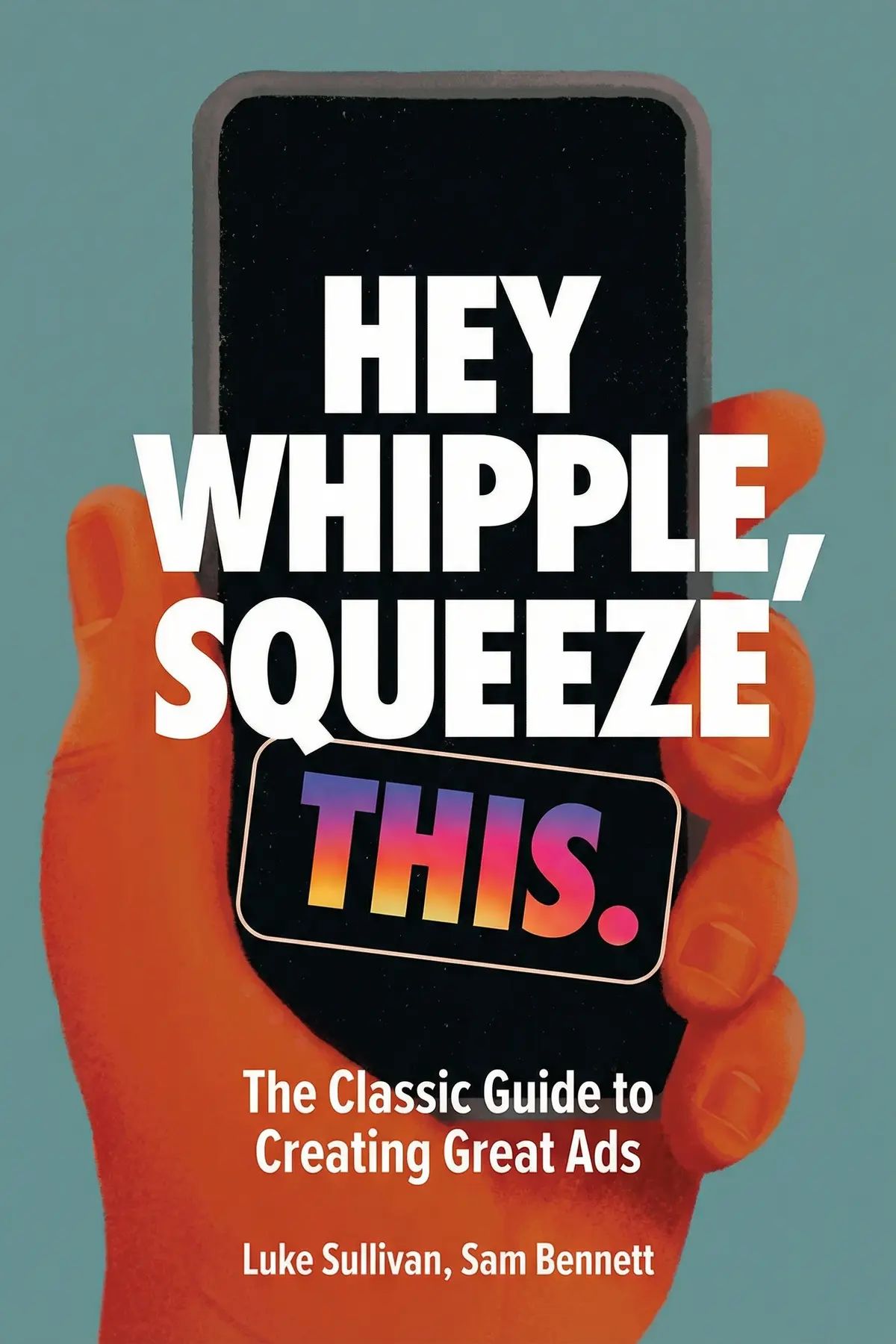
Table of Content
1. Introduction
56 sec
Most people who want to make ads picture clever people waiting for inspiration, but the real work is closer to chasing a muddy pig around a yard. In Hey Whipple, Squeeze This!, Luke Sullivan and Sam Bennett show that ads which seem to sum up the world in half a minute usually start from one plain, true statement, reached through stubborn effort.
That idea runs through everything here: great advertising is hard, messy work aimed at a single simple truth, then shaped for the medium and for customers who can check your claims in seconds. The route runs from breaking into the business, through ways to get unstuck, to why Volvo owns one word, how Volkswagen made a tiny car charming and what holds attention on television and radio. Whether you are pitching an agency or writing copy for your own company, the result is a working method for finding the one line worth saying.
2. Land an agency job with a few great ideas
1 min 37 sec
Ad schools now turn out graduates with beautifully finished portfolios, and the competition grows every year. Agencies still look first for one thing, and a rough sketch on a napkin can show it.
3. Stay calm when the brief turns into a warthog
1 min 37 sec
An account manager wants a pig washed by three o’clock tomorrow. The comic picture the authors build from this explains why creative work feels so chaotic, and why the worst moment is normal.
4. Get unstuck when the blank page wins
1 min 48 sec
Every writer hits the wall where nothing comes. The authors offer practical ways back into the flow, including the reading one of them did before writing a line for a family magazine.
5. Own one word in the customer's mind
1 min 28 sec
Ask almost any audience what one car brand stands for and they answer in a single word, every time. The rankings tell a different story, which shows what good advertising can build.
6. Turn an awkward truth into your best line
1 min 21 sec
In 1964 Volkswagen had a small, underdog car and every reason to stay quiet about it. Instead it put the weakness at the center of an ad, and readers found it charming.
7. Make the company live up to its ads
1 min 36 sec
Customers can now check any claim from their phones, which changes what an ad has to do. A drinks giant and a set of giant arrows over London show the new rules.
8. Hook viewers with a spot's first and last seconds
1 min 34 sec
Most viewers leave the room when the commercials start. A road safety ad that spread online within weeks shows which two short windows keep them watching, and why one alone is not enough.
9. Radio dialogue that sounds like real people
1 min 35 sec
Many people assume a radio ad must be funny to work. An older man remembering his first house made listeners trust a bank, and his ad points to a quieter kind of craft.
10. Conclusion
1 min 08 sec
Hey Whipple, Squeeze This! keeps arriving at the same place from different directions. Building a portfolio, staring at a blank page, defending a brand online or cutting a radio script, the work is long and messy, and the reward is something short and plain: one word like safety, one honest line about a small car, one silence in the right spot. The effort is what makes the simplicity possible.
The authors add a piece of advice that reaches well beyond agencies. Do not waste hard work by presenting it carelessly; learning to present with confidence pays off across a whole career. Spend time with your clients, get to know their culture and their sense of humor, and learn what they expect from an ad, because that familiarity also builds the trust that brings future work.
So the next time you need to sell an idea, choose the one word you want people to remember and find the true thing behind it. Open with something strange and close with something to think about. And when the client walks in asking for a warthog, reach for the vanilla wafers and start again.
About this book
What is this book about?
Advertising looks glamorous from the outside: clever people wait for inspiration, then wow the client. Luke Sullivan and Sam Bennett describe something messier. Clients change their minds, every brief is different, and the ads that seem to say everything in thirty seconds usually come from one plain statement that took a lot of effort to find. The book follows that idea from the first job application to the finished spot. It explains why agencies hire for ideas rather than polish and how a few practical tricks get a stalled writer moving again. It shows how Volvo came to own the word safety and how Volkswagen turned a tiny car into a joke that sold it. It also argues that, now that customers can check any claim online, a company has to act the way its ads promise. The authors then get practical about two media. On television, the first two seconds and the last five carry the spot. On radio, natural voices, real dialogue and well-placed silence beat forced humor. Anyone who writes to persuade, inside an agency or not, gets a working method for finding the one line worth saying.
Book Information
Who it's for
Building an ad portfolio
Students and career switchers building a portfolio to get into an ad agency.
Copywriters and creatives
Copywriters and creatives who freeze in front of a brief and want ways to get unstuck.
Writing their own ads
Founders and marketers writing their own ads who want one clear, honest message.
About the Author
Luke Sullivan
Luke Sullivan wrote Hey Whipple, Squeeze This! and later published Thirty Rooms To Hide In, a memoir about growing up with five brothers in Minnesota during the 1950s and 1960s. Sam Bennett works in digital strategy at the Austin agency GSD&M, having started her digital career at T3. At GSD&M she has worked for national brands such as Walmart, John Deere and BMW, and has focused on digital work for Marshalls, Legacy and Jarritos.
Ratings & Reviews
Ratings at a glance

What people think
Listeners find the work to be an extremely worthwhile resource that provides plenty of actionable guidance.
Top reviews
Charlotte
After hearing so much buzz about this in my advertising seminar, I finally cracked it open and I am genuinely impressed. Usually, textbooks are dry and clinical, but Luke Sullivan writes with a voice that feels like a mentor grabbing a beer with you. He manages to illustrate his points about good advertising with concrete examples from print ads and radio scripts, explaining exactly why they work. I especially loved the section on social interactions—that distinction between the 'Here I am' and 'Ah, there you are' mentality is something I’ll use in my personal life. While the digital landscape has obviously exploded since the earlier editions, the psychological foundation remains rock solid. It’s funny, instructive, and frankly, a breath of fresh air compared to most dry marketing manuals.
Show moreNarut
The chapter on building a portfolio alone is worth the price of admission for anyone trying to break into the creative side of the business. I didn't expect to enjoy an advertising book this much, yet Sullivan's memoir-style approach makes the heavy lessons stick. He breaks down the most popular campaigns of the 20th century with such precision that you start seeing the world through a different lens. I kept my phone next to me to look up the print ads he mentioned, which I highly recommend doing. It’s one thing to hear about a great ad, but seeing the visual execution alongside his analysis makes it click. Even the parts about radio scripts, which I thought would be boring, were packed with useful and interesting tidbits.
Show moreTaweesak
Finally got around to reading this and I can't believe how much it made me laugh while teaching me actual craft. The author illustrates his points with such concrete examples that you can't help but learn the principles by osmosis. I loved his take on attention spans; apparently, even in the 'frenzied era' of the past, people were just as distracted as they are today. That realization alone makes the advice feel much more timeless than some critics might suggest. Whether he's talking about the 'squeeze' of a TV spot or the nuances of print, Sullivan's voice remains consistently engaging. It reads almost like a novel at times, which is rare for a how-to book. I'd recommend this to anyone in marketing who wants to do work they are actually proud of.
Show moreChai
This book is essentially the blueprint for how to create advertising that people don't actually hate. Luke Sullivan is an exceptional writer who manages to be both informative and hilarious, often in the same sentence. I particularly enjoyed the anecdotes about his early career and the irritating TV spots that drove him to do better work. It’s full of truth about the industry, from the creative highs to the soul-crushing client meetings we all deal with. Even though it was assigned for a class, I ended up reading ahead because I was genuinely interested in the stories. The jokes in brackets are a highlight and they actually work to drive the points home. If you are in advertising, you need this on your desk.
Show moreLiam
Picked this up after reading a few other books on the ad business that felt like get-rich-quick schemes for freelancers. Sullivan’s approach is much more honest and detailed, focusing on the actual technique of writing and the reality of the agency environment. He explains precisely why certain print ads and radio scripts are effective, which is so much more helpful than vague advice about 'branding.' Not gonna lie, I was surprised by how much I learned about salary negotiations and navigating the corporate ladder. The book is an excellent springboard for anyone entering the field, even if you don't agree with every single opinion he has. It's rare to find a professional development book that is this entertaining. I’ll definitely be looking into the other books he recommends.
Show moreManika
Look, the industry has shifted a lot since this was first published, but the core principles Sullivan lays out remain incredibly sturdy. Even though I work in market research rather than creative copywriting, seeing the internal mechanics of a campaign was eye-opening. The book does get a little repetitive toward the middle, as many non-fiction books do, but the humor kept me engaged through the slower chapters. Sullivan is clearly an exceptional writer who speaks to his audience as equals rather than students. I found the anecdotes about dealing with difficult clients to be the funniest and most relatable parts of the entire read. If you want to understand how to avoid the cliches that make most commercials unbearable, this is a great place to start.
Show morePear
As someone who works mostly in graphic design, I found the breakdown of creative techniques to be incredibly useful for my own workflow. Sullivan’s writing style is punchy and he writes exactly the way he speaks, which makes the complex concepts easy to digest. Personally, my favorite part was the section on avoiding cliches, as it really challenges you to think beyond the first 'easy' idea that pops into your head. There were some clever ads analyzed that I had never even heard of before, which provided great inspiration. I did feel it was a bit long-winded in the sections regarding client interactions, but the humor carried me through. It’s not just for writers; it’s for anyone who wants to be more creative in a professional setting.
Show moreGun
Gotta say, I was worried this would be another hyped-up business book, but it’s actually a very practical guide. The distinction between 'Here I am' and 'Ah, there you are' really resonated with me on both a professional and personal level. Sullivan isn't just teaching you how to write copy; he's teaching you how to think like a human communicator in an automated world. Truth is, if you are looking for a guide on SEO or TikTok algorithms, you should probably look elsewhere. This is about the art of the idea, which is the foundation that never truly changes regardless of the platform. The advice on how to negotiate salary is particularly grounded and realistic for newcomers. I’m glad I took the time to absorb it.
Show moreJeeranan
Ever wonder why every ad student treats this like the Bible? To be honest, I walked in skeptical because of all the hype, but I left with mixed feelings about the final product. The author is admittedly a bit of a character, and his jokes in brackets actually land more often than not, which is rare for this genre. However, it did get pretty repetitive after a while, cycling through similar points about simplicity and 'the big idea' without much new ground. It’s a classic for a reason, but I’m not sure how much of it will be useful since I’m not the person actually writing the ad campaigns. It's an excellent springboard, but maybe not the be-all-and-end-all for everyone in the business.
Show moreThanit
Not what I expected from a book that everyone claims is a must-read classic in the field. While there is definitely some practical advice buried in here, the tone struck me as a bit pompous and self-congratulatory. It feels like a veteran ad man shouting at clouds about how things used to be better back in the day before the internet ruined everything. The examples are classic, sure, but the landscape has changed so much that half the advice feels irrelevant for a digital-first world. I’m sure it’s helpful for a very specific type of old-school copywriter, but I found it hard to get through the ego. It's a total dud if you're looking for modern, actionable digital strategies.
Show moreQuestions about this book
What is Hey Whipple, Squeeze This! about?
Luke Sullivan and Sam Bennett explain how great ads get made. They argue that the work is messy and demanding, but that the best ads come from one simple, true idea. The book covers building a portfolio, getting past creative blocks, finding a single word for a brand, making companies live up to their ads, and writing for television and radio.
How do you build an advertising portfolio according to Hey Whipple?
The authors recommend eight or nine imaginary campaigns, each worked to a high standard and built on strong ideas, since agencies care more about ideas than finished polish. Start with products you use, study award-winning ads to see why they worked, then create ads for products you would never buy, to show your talent works across fields.
What makes a good TV commercial in Hey Whipple, Squeeze This!?
The authors focus on two moments. The first two seconds should show something unusual that creates a curiosity gap and keeps people watching. The last five seconds should resolve the story in a way that makes people think. A surprising image alone is forgettable, and a twist alone loses its punch after one viewing, so a strong spot needs both.
How can I apply the ideas in Hey Whipple to my own marketing?
Choose one adjective you want customers to link with your product, as Volvo did with safety. Look for the truth about your product, even an awkward one, the way Volkswagen joked about its tiny Beetle. Make sure the company’s actions back up the claim, since customers can check online. And present your work with care, after getting to know the client.
Do radio ads need to be funny?
No, according to the authors. Natural, sincere ads often work better, like a First Tennessee Bank spot in which an older man recalls the joy of buying a house when he was young. Background sound can set a scene, dialogue should sound like real people talking in fragments, product details belong in a voice-over, and fewer words leave room for pauses and silence.
Readers also enjoyed







AUDIO SUMMARY AVAILABLE
Listen to Hey Whipple, Squeeze This! in 15 minutes
Get the key ideas from Hey Whipple, Squeeze This! by Luke Sullivan, plus 5,000+ more nonfiction titles.
- 5,000+ titles
- Listen as much as you want
- 7-day free trial
- Cancel anytime









