

13 min 13 sec
Available in: English
From Founder to Future: A Business Roadmap to Impact, Longevity, and Employee Ownership
By John Abrams
A practical guide for small business owners who want to step away without losing what the company stands for, by passing ownership, leadership and decision-making to employees through co-ops, trusts and careful planning.
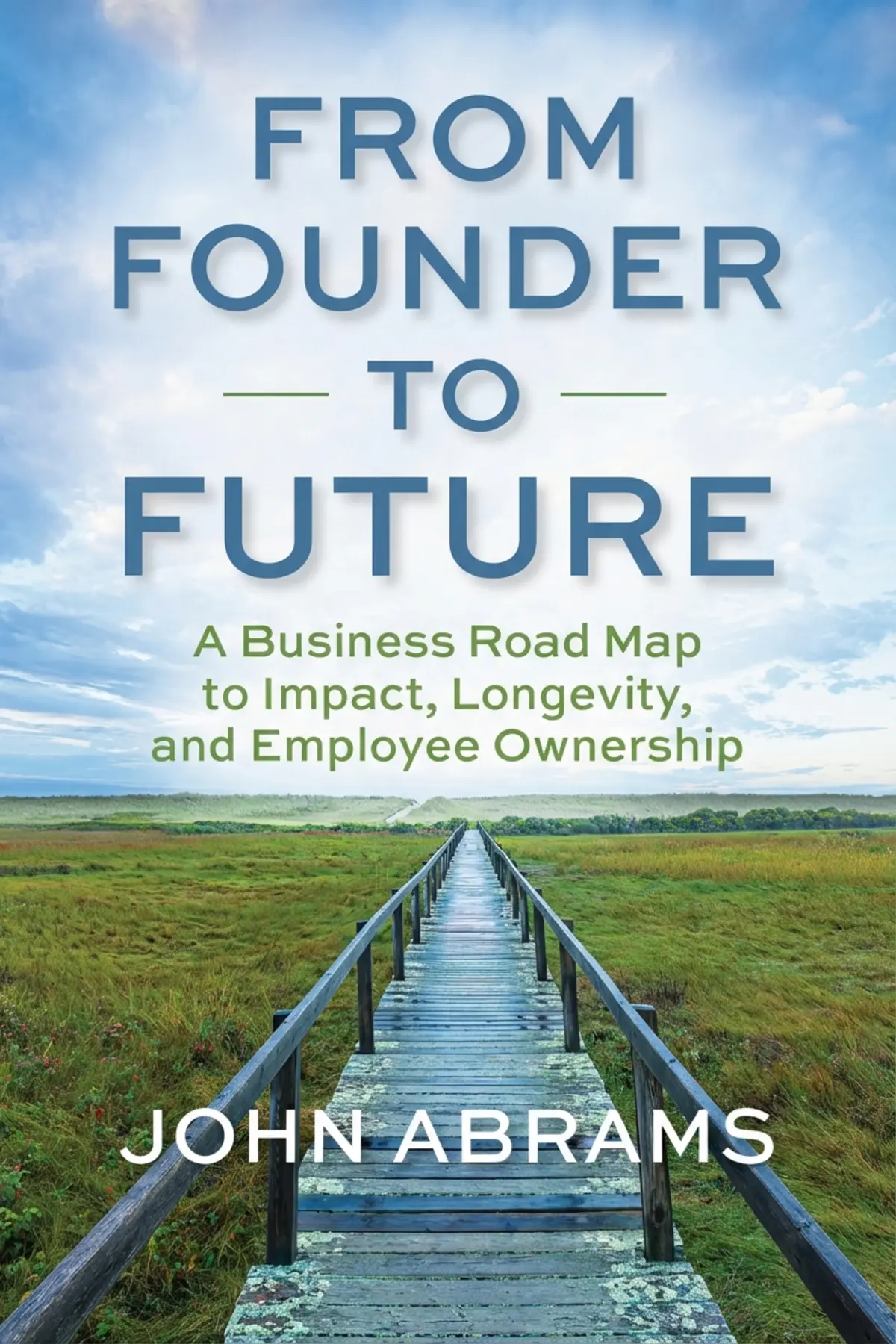
Table of Content
1. Introduction
59 sec
If you own a small business, the usual endings are grim: sell to an outside buyer, hand control to investors who want a quick exit, or close the doors. In From Founder to Future, John Abrams, who led the builder South Mountain Company for more than forty years, argues for a fourth path. Give the company to the people who already make it work, and build the structures that keep its purpose alive.
His central claim is that values do not survive a founder’s departure through goodwill. They survive when they are written into who owns the business, who leads it and how everyday decisions get made, and when that design begins long before the founder is tired.
Abrams makes his case with worker cooperatives, employee trusts and regional networks from Oregon to the Basque Country of Spain. What follows gives an owner a map of the real options, the weak points in each, and a clear sense of where to begin while there is still time to choose.
2. Start planning your exit years before you leave
1 min 51 sec
Many good small companies end in a rushed sale or a closure nobody wanted. The cause is rarely bad luck, and a building firm from the 1970s shows what a different ending can look like.
3. Hand the company to the people who run it
1 min 41 sec
Selling to the highest bidder can feel like a betrayal of everything a company stands for. A web studio with 16 people and a lumber business that is 130 years old found another way out.
4. Build your conversion team from proven specialists
1 min 54 sec
Ten years ago, a founder who wanted to sell to employees had almost nobody to call. The people now doing this work, from lawyers to lenders, change what a small owner can realistically attempt.
5. Connected co-ops outlast lone ones and multiply their impact
2 min 03 sec
A single worker-owned shop is exposed to every downturn and every bad year. In one corner of Spain and one region of Italy, something larger grew from linking many of them, and it now appears in rural North Carolina.
6. Choose an ownership design that resists a sale
1 min 53 sec
Employee ownership sounds permanent, yet a celebrated brewery shows it can vanish in a single deal. The difference between structures that hold and structures that fold often sits in the fine print.
7. Hand over leadership and daily management with your values intact
1 min 47 sec
A founder can transfer every last share and still watch the culture fade within a few years. The missing pieces are the people who will lead and the way ordinary decisions get made each day.
8. Conclusion
1 min 05 sec
Abrams’ book adds up to a reversal of how founders usually picture the end. The exit is not one sale on one day. It is a long piece of design work, and what it produces is a company able to keep its promises after the person who made them has left.
South Mountain needed years to build leaders who could run it without its founder. ReVision Energy needed rules that make a sale hard. The Industrial Commons needed neighbors. New Belgium shows what can happen when the design stops at the shares.
For an owner, the work can start small. Find out what a co-op conversion or an Employee Ownership Trust would mean for your company, and talk to a group that has guided one. Choose the people who could lead after you and begin teaching them the culture as well as the numbers. Open the books a little wider than feels comfortable, so staff learn to share decisions before they share ownership.
A founder cannot hold the values in place forever. A well-built company can.
About this book
What is this book about?
Most small business owners face a narrow set of endings: sell to an outside buyer, take investor money and exit fast, or close the doors. For founders whose companies stand for something beyond profit, none of these feels right. John Abrams argues there is another path, and it is getting easier to take. Drawing on his own company, South Mountain, which grew from a small builder into a worker-owned cooperative, Abrams lays out five shifts that move a business from depending on its founder to being shared and built to last. He explains how worker cooperatives function, who now helps with legal work and financing, and why networks of co-ops from Spain to North Carolina make each member stronger. He also compares employee stock plans with newer employee ownership trusts, using the sale of New Belgium Brewing as a warning. Readers get a clear view of the real succession options, the weak points in each, and a plan for handing over ownership, leadership and management in stages, so the company's purpose survives the founder's exit.
Book Information
Who it's for
Founders nearing retirement
Small business founders nearing retirement who want their company to keep its purpose after they leave.
Owners considering selling
Owners weighing a sale who are uneasy about private equity, a quick exit or closing down.
Managers and long-serving staff
Managers and long-serving employees who may one day share ownership and need to understand co-ops and trusts.
About the Author
John Abrams
John Abrams co-founded South Mountain Company and served as its President for more than forty years. In the late 1980s he converted it into a worker cooperative, and in 2022 he handed it to the next generation of leaders. That same year he and his partner, Kim Angell, founded Abrams+Angell to help small businesses meet social, environmental and financial goals. His own work centers on guiding companies through conversion to worker cooperatives.
Ratings & Reviews
Ratings at a glance

What people think
Listeners find the book delivers useful direction without becoming too dense, as one review notes it offers actionable advice. It is also seen as an uplifting resource, with one listener calling attention to its thorough strategy for business growth. Additionally, the content receives praise for exploring employee ownership frameworks, and one listener characterizes the work as a pleasant experience for organization founders.
Top reviews
Isabelle
Abrams has managed to distill decades of boots-on-the-ground experience into a framework that feels both radical and inevitable. The concept of the 'CommonWealth company' is particularly striking because it moves beyond mere profit-sharing into a deeper sense of stewardship. I appreciated how he broke down the five transitions; they provide a much-needed map for founders who feel trapped by the traditional 'sell-to-the-highest-bidder' exit strategy. Truth be told, the prose is a bit dense in the middle sections, but the case studies keep the momentum going throughout. It is a visionary look at how we can rebuild our local economies from the inside out using business as a primary tool for good.
Show moreEye
As a small business owner staring down the barrel of retirement, I found this book to be an absolute lifeline. I’ve spent thirty years building a team that feels like family, and the idea of selling to a private equity firm made me lose sleep. Abrams offers a different path that prioritizes the people who actually did the work. The personal anecdotes about South Mountain Company added a layer of authenticity that you just don't get from academic business texts. It is deeply inspiring to see that success doesn't have to mean selling out your community for a quick payday. I finished it feeling like my legacy might actually be safe in the hands of my staff.
Show morePloy
The discussion guide at the end is a total game-changer for anyone trying to socialize these ideas within their own company. I’ve already shared several chapters with my management team to spark a conversation about our long-term trajectory. Abrams writes with a 'legend in the field' authority, yet he remains remarkably humble about the learning curve involved in shared ownership. The book succeeds because it treats employees as partners in a shared future rather than just line items on a balance sheet. It’s a roadmap for those of us who believe business can be a force for systemic good. I especially liked the focus on regional impact and the wider business ecosystem.
Show moreAndrei
Rarely do you find a business book that balances such lofty philosophical goals with such grounded, practical advice. I’ve been following John Abrams’ work for years, and this feels like the culmination of his life’s mission to change how we think about ownership. He manages to explain the mechanics of complex ownership structures without ever losing sight of the human element. The idea that a company can outlive its founder while staying true to its original purpose is incredibly heartening. If you are serious about legacy, you need to read this book before you make any final decisions about your company’s exit plan. It offers a clear, understandable path forward.
Show morePriya
John Abrams’ previous work set a high bar, but this new volume manages to exceed it by focusing on the broader future of business. I was particularly impressed by the transparency regarding the challenges of the transition process. It’s not just a 'how-to' manual; it’s an invitation to join a movement of companies that prioritize the common good over short-term gain. The five transitions he outlines are logical and provide a clear timeline for action. I finished the book feeling a renewed sense of hope for what our local economies could look like in twenty years if we embrace these models. It's a must-read for students of shared ownership.
Show moreRafael
Finally, a guide that doesn't just preach about values but actually shows you how to bake them into your legal structure. I picked this up because I’m helping a client through a succession crisis, and the clarity Abrams provides on ESOPs versus worker co-ops was invaluable. It’s not a quick read, nor should it be, given the weight of the subject matter. To be fair, I would have liked more focus on the tax implications of these transitions, but as a primer on mission preservation, it’s top-tier. The tone is encouraging without being overly optimistic about the hurdles involved. Any founder looking to retire should consider this an essential part of their toolkit.
Show moreWan
While some of the legal nuances were a bit dense for me, the overall message of the book is undeniably powerful. Look, most business books are 200 pages of fluff wrapped around a single blog post's worth of insight, but this is different. It’s a heavy-duty manual for structural change that doesn't shy away from the hard questions. I was particularly fascinated by the section on how these models enhance worker-life balance. It makes sense—when you own the place, you have a vested interest in making sure the pace of work is sustainable. A few parts felt repetitive, but the core message about mission-driven growth is essential for the modern era.
Show moreNatchaya
We talk a lot about 'scaling up' in the tech world, but Abrams asks us to consider 'scaling deep.' This shift in perspective is what makes this book so vital for the current economic moment. The author’s focus on regional change through a robust ecosystem of employee-owned firms is exactly the kind of big-picture thinking we need right now. Frankly, the writing is a bit dry in the technical chapters, but the passion behind the mission shines through. It’s a solid resource for anyone who cares about the intersection of business and social justice. I'll be recommending this to my local Chamber of Commerce for their next study circle.
Show moreUbolrat
Not your typical dry business text, this book actually tells a story about where we are headed if we choose the right path. I appreciated the way Abrams blends the 'why' with the 'how,' even if the 'how' got a little bit technical for my taste at times. It’s clear the author has a deep love for his community and for the people he’s worked with over the decades. Not gonna lie, I think some of the timelines he suggests might be a bit optimistic for larger, established firms. Still, the core framework is brilliant and very much needed to address the massive wealth gap in our current system.
Show moreViroj
I’ll be the first to admit that I struggled with some of the more idealistic projections in these pages. The 'CommonWealth' model sounds wonderful in theory, but I wonder how it holds up in high-growth, venture-backed environments that require fast capital. To be fair, Abrams is clearly writing for a specific type of mission-driven founder, and for that audience, this is a five-star resource. For those of us in more traditional corporate settings, the transition feels like a monumental mountain to climb. The case studies are well-researched, though I found myself wishing for more examples of failures to see what we should avoid. It's a noble vision, if a bit niche.
Show moreQuestions about this book
What is the main idea of From Founder to Future?
John Abrams argues that a founder’s values only survive a handover when they are built into the company’s structure: who owns it, who leads it and how daily decisions are made. He describes five shifts toward a shared, lasting business and shows how worker cooperatives, employee trusts and co-op networks make that possible for small firms, drawing on his own company, South Mountain, as the main example.
What is a worker cooperative and how does it help with succession?
In a worker cooperative, every worker-owner has a single share and a single vote, so members make decisions together and share in the company’s success. Abrams presents conversion as a practical exit: the founder sells on fair terms, often with tax advantages, and control stays with people who know the business. Firms such as PixelSpoke in Oregon and Ward Lumber in upstate New York used it to protect their culture and reward long-time staff.
What is the difference between an ESOP and an Employee Ownership Trust?
In an ESOP, a trust holds company stock and employees gain financially without owning shares directly. Abrams notes ESOPs have helped millions build wealth but are complex, costly and often end in a sale, as with New Belgium Brewing. An Employee Ownership Trust is more flexible and cheaper. The trust owns the company for employees and reinvests profits in their wellbeing, though workers do not build equity.
Who helps a business convert to employee ownership?
Abrams describes a support network that has grown sharply in recent years. In the United States, most conversions are handled by the Cooperative Development Institute, Project Equity and ICA Group. Start.coop in Boston helps co-ops grow. Some states have worker co-op laws, firms like Jason Wiener’s combine legal and cultural design, and lenders such as CFNE finance buyouts, usually alongside financing from the selling owner.
How can a founder start applying the book's ideas?
Begin soon, while choices are still open and your energy holds. Learn the full range of ownership options and speak with an organization that has guided conversions. Identify and develop the next leaders well in advance, teaching culture and ethics alongside operations. Introduce participatory practices such as open-book management and team decisions, and design each phase on purpose rather than trying to change everything at once.
Readers also enjoyed


A Bigger Prize: How We Can Do Better Than the Competition
Margaret Heffernan





A Year with Peter Drucker: 52 Weeks of Coaching for Leadership Effectiveness
Joseph A. Maciariello


AUDIO SUMMARY AVAILABLE
Listen to From Founder to Future in 15 minutes
Get the key ideas from From Founder to Future by John Abrams, plus 5,000+ more nonfiction titles.
- 5,000+ titles
- Listen as much as you want
- 7-day free trial
- Cancel anytime









