

A Life Decoded: My Genome: My Life
J. Craig Venter
 English
Shows how some famous postmodern thinkers misused physics and mathematics to sound profound, why their obscure prose went unchallenged for so long, and why giving up on objective truth harms courts, medicine and progressive causes.
1 min 10 sec
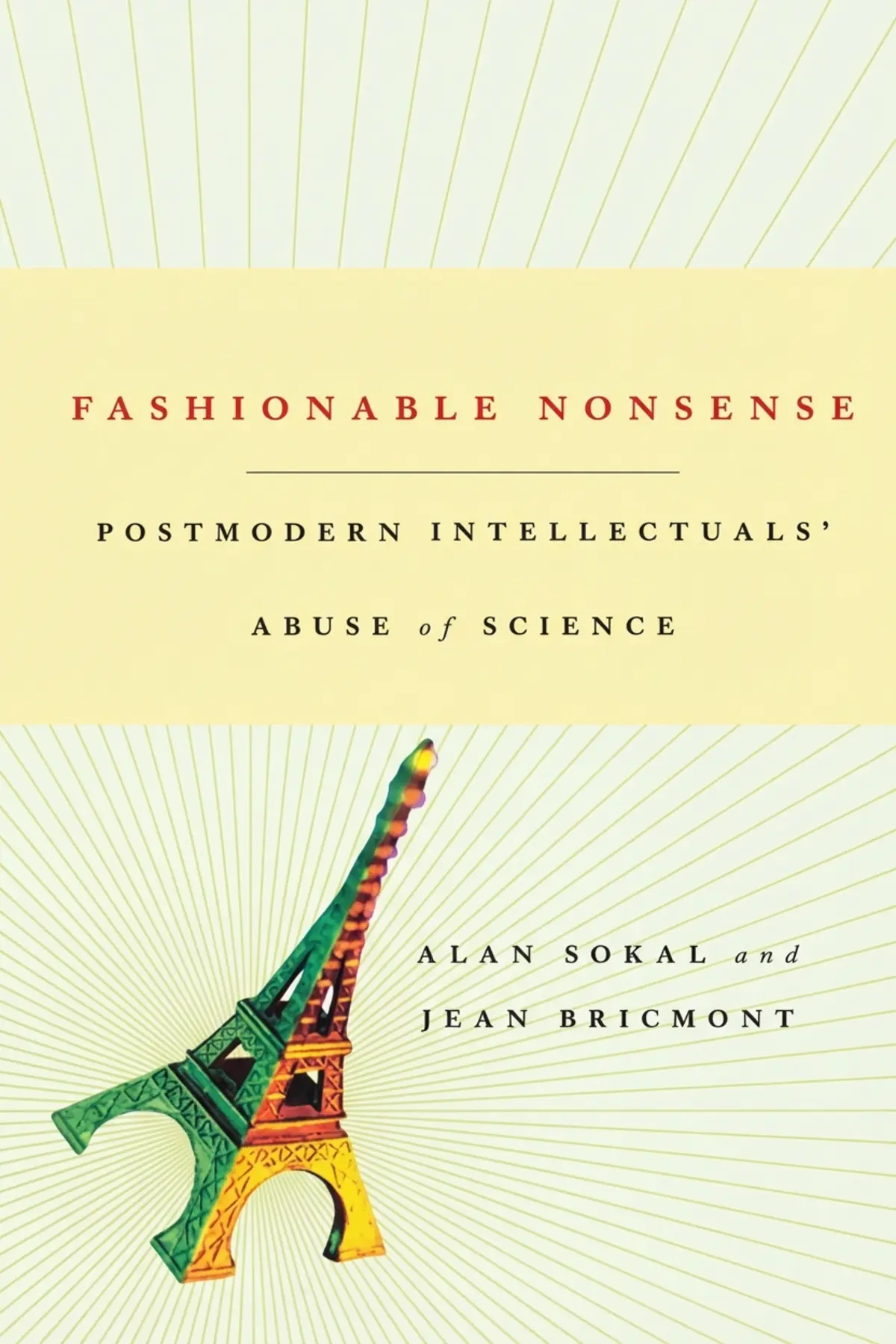
Most of us have nodded along to a dense academic or corporate text, assuming the confusion was our own fault. Sometimes, though, the text means nothing at all. In Fashionable Nonsense, two scientists, Alan Sokal and Jean Bricmont, show how a strand of postmodern thought dressed up vague claims in borrowed scientific language, and how easily that costume fooled the experts. The proof arrived in 1996, when Sokal got a deliberately meaningless paper accepted by the journal Social Text and then revealed it as a hoax.
Their case reaches well beyond one prank. When thinkers deny that any objective truth exists and misuse physics and mathematics to sound profound, the authors argue, the damage spreads past the seminar room. It weakens the shared respect for evidence that courts, medicine and honest debate rely on. What you gain here is a working test for impressive prose that may be empty, a fair account of what postmodernism got right, and the authors’ case that progress begins with plain, honest speech.
2 min 18 sec
A physics professor wrote a paper designed to mean nothing and sent it to a respected journal. The editors printed it. The tricks he used still work today, in boardrooms as well as universities.
2 min 13 sec
One side says a tribe’s origin story is as true as the archaeological record. The other says only one account can describe what happened. The authors take both the respect and the facts seriously.
2 min 13 sec
A famous psychoanalyst brought imaginary numbers into his theory, and a celebrated philosopher used chaos theory to explain history. A short test shows whether the science in an argument is carrying weight or just decorating it.
2 min 19 sec
Prose that nobody can follow should lose readers, yet in some circles it gains them. The authors trace the history behind that reversal and the social reward that keeps it going.
2 min 08 sec
Endless doubt sounds open-minded in a seminar. Bring it into a courtroom or a medical lab and something breaks. The authors explain who pays when the line between fact and fiction blurs.
1 min 21 sec
A paper about the hermeneutics of quantum gravity, written to mean nothing, still makes a sharp point. A respected journal printed claims its own experts could not judge, because they sounded like the right kind of thinking. Once a community decides that truth is only a matter of perspective, borrowed science becomes a costume and obscurity passes for depth. The people who most need facts, from juries to patients to the targets of hate speech, are left with less to defend them.
The authors keep what postmodernism did well, its respect for other cultures and its suspicion of grand theories. They ask only that respect and accuracy stay separate questions.
Their tools fit into an ordinary week. When a text dazzles you, restate it in one plain sentence and see what remains. When a writer borrows a technical term, check whether the argument needs it. When a disagreement stalls, sort the reasonable doubts from the unreasonable ones and name the evidence that would decide it. And when you write, choose the clearer sentence even if it sounds less impressive.
A better world, as Sokal and Bricmont see it, is built on clear and honest conversation. Fog protects only the people making it.
In 1996, Alan Sokal got a deliberately meaningless paper into the journal Social Text, then announced it was a hoax. The paper was full of fashionable jargon, flattering citations and claims that even physical reality is a social construct, and the editors published it anyway. Fashionable Nonsense, written with the Belgian physicist Jean Bricmont, explains what that prank exposed. The authors take aim at postmodernism, the intellectual trend that holds there is no objective truth and that all knowledge, science included, is socially constructed. They give it credit for checking the overconfidence of modernism and widening the range of voices heard. But they show leading figures such as Jacques Lacan, Luce Irigaray and Jean Baudrillard using mathematics and physics in ways that range from irrelevant to absurd. Readers learn how to recognize prose that only sounds deep, why incomprehensible writing earns prestige, and why the authors believe extreme relativism hurts the very causes it claims to serve. They argue it weakens trials, medical research and the fight against nationalist and fundamentalist irrationalism.
Students and researchers in the humanities or social sciences who struggle with dense theory and wonder whether it means anything.
Professionals who read reports, essays and strategy documents and want a test for jargon that hides empty claims.
Anyone worried about the fading line between fact and opinion in public debate.
Alan Sokal, born in 1955, is an American who teaches mathematics at University College London and has held a physics post at New York University. His 1996 hoax paper in Social Text became known as the Sokal affair. Jean Bricmont, born in 1952, is a Belgian theoretical physicist and philosopher of science at UCLouvain, a member of the Royal Academy of Belgium since 2004, and a self-described rationalist who led the Association française pour l'information scientifique from 2001 to 2006.

Listeners find the work to be well-crafted, amusing, and intellectually stimulating, with one listener emphasizing its successful critique of postmodern relativism. Additionally, they praise the book’s storytelling and momentum, and one listener remarks on its brilliant skewering of "left-wing cant." Conversely, the ease of reading draws varied responses; while some consider it highly fascinating, others describe the work as incomprehensible.
This book is a surgical strike against the intellectual laziness that plagued late 20th-century humanities. Sokal and Bricmont don't just complain about postmodernism; they systematically dismantle the way thinkers like Lacan and Kristeva used scientific terminology they clearly didn't understand. It is incredibly satisfying to see someone finally point out that the emperor has no clothes when it comes to these dense, supposedly 'profound' texts. The authors maintain a tone of controlled exasperation that makes for a surprisingly engaging and often humorous read. While the math sections can be dense, the general argument against epistemic relativism is accessible to any rational reader. Frankly, it serves as a necessary defense of objective truth in an era where 'social construction' is used as a shield for poor logic. Every student of the social sciences should be required to grapple with these arguments before diving into continental philosophy.
Show moreAs someone who identifies with the political left, I found Sokal’s critique of postmodern 'fashionable nonsense' to be incredibly refreshing and necessary. He argues that by abandoning rationality and evidence, the left loses its most powerful tool for social change. The book is a brutal takedown of the 'sharlatans' who use obscure language to hide a lack of actual content. Seeing the specific examples of how E=mc^2 was labeled a 'sexist equation' makes you realize how far some academics have drifted from reality. The writing is sharp, witty, and surprisingly fast-paced for a book about the philosophy of science. It serves as a vital reminder that obscure language is not a synonym for deep thought. Truth is, we need more scientists willing to step into the humanities to keep the discourse grounded in facts.
Show moreAfter hearing about the Sokal Hoax for years, seeing the actual analysis of how these intellectuals abuse topology and quantum physics was eye-opening. The book is a masterclass in intellectual honesty, showing exactly where the line is crossed between metaphor and misinformation. Sokal and Bricmont are fair but firm, giving these authors enough rope to hang themselves with their own incomprehensible prose. The way they handle Jacques Lacan is particularly devastating, exposing his 'mathematical' models as little more than smoke and mirrors. I found the book to be thought-provoking and surprisingly easy to follow, provided you skip some of the more intense equations. It's a brilliant skewering of the way some academics try to 'look' smart rather than actually saying anything of value. Personally, I found it to be one of the most refreshing books on philosophy I've ever read.
Show moreEver wonder how many famous philosophers are actually just throwing around scientific buzzwords to sound profound? Sokal and Bricmont provide a hilarious yet devastating answer by quoting long passages of absolute gibberish from icons like Deleuze and Guattari. The book brilliantly skewers the 'left-wing cant' that replaces empirical evidence with opaque, poetic metaphors masquerading as physics. I found the chapter on Luce Irigaray’s feminist critique of fluid mechanics particularly eye-opening because of how blatantly the scientific concepts were distorted. To be fair, some of the technical explanations of topology and calculus might go over the head of a layperson. However, the sheer absurdity of the quoted passages makes the point clear enough even if you aren't a physicist. It is a thought-provoking narrative that challenges the way we grant authority to academic superstars.
Show moreWow, the chapters on Jean Baudrillard and his bizarre misuse of non-Euclidean geometry are worth the price of admission alone. Sokal and Bricmont do an excellent job of showing that these aren't just minor metaphors; they are foundational errors that render the original arguments meaningless. The tone is often funny, treating the philosophers with a sort of polite bafflement that highlights the absurdity of their writing. I especially liked the section on 'epistemic relativism' because it explains why this academic trend is actually dangerous for society. My only complaint is that the book can feel a bit like 'preaching to the choir' at times. If you already suspect that postmodernism is mostly hot air, you'll love this, but it might not convince a die-hard Derrida fan. Still, it’s a brilliant skewering of pretension that remains very relevant today.
Show moreFinally got around to reading this classic of the 'Science Wars,' and its relevance hasn't faded a bit since the late nineties. The authors provide a much-needed reality check for the academic world, showing how 'deliberately obscure language' is used to dupe snobbish readers into seeing depth where none exists. I found the narrative quality surprisingly high, with Sokal and Bricmont leading the reader through complex ideas with clarity and wit. They aren't just attacking the left; they are defending the very idea that an external world exists and can be understood through reason. It's a sobering look at how easily intellectual standards can slip when people value style over substance. Some of the quotations are so dense they are almost incomprehensible, which only proves the authors' point. This is a must-read for anyone who values clear thinking over academic posturing.
Show moreNot what I expected, but in a good way—it’s much more than just a follow-up to a famous prank. The authors use the hoax as a jumping-off point to discuss the wider crisis of truth in the social sciences. They address the 'science wars' with a level of detail that shows they aren't just out for blood; they genuinely care about the integrity of academic discourse. The readability is generally good, though the chapters on specific French authors can get a bit repetitive if you read them all at once. I appreciated the effort to explain the actual science behind the concepts being abused, like relativity and chaos theory. It’s a humorous, well-written, and ultimately important book that challenges the reader to think more critically about the 'fashionable' ideas we consume. Just be prepared for some very dense blocks of text from the philosophers themselves!
Show morePicked this up expecting a lighthearted romp through academic satire, but I found myself bogged down in the technical math. While the Sokal Hoax itself is a brilliant piece of performance art, the book version feels a bit like a repetitive list of grievances. The authors quote pages of French philosophy and then spend several more pages explaining why the math is wrong, which becomes dry after a while. I appreciate the critique of postmodern relativism, but the readability is a bit of a mixed bag for someone without a STEM background. It's definitely an important document for the 'science wars,' but it isn't exactly a page-turner for a casual Sunday afternoon. Some of the 'intermezzos' are great, though, especially the ones discussing the misuse of Kuhn and Popper. If you want a deep dive into why Lacan's use of topology is nonsense, this is for you, but others might find it a bit tedious.
Show moreIn my experience, this book is best read in small doses because the sheer volume of academic nonsense being debunked can be overwhelming. Sokal and Bricmont are excellent guides, but the structure of the book—alternating between long quotes and scientific corrections—gets predictable. They do a great job of explaining the 'Strong Programme' and why its brand of relativism is flawed, which was the most interesting part for me. However, I sometimes wondered if these philosophers are still as influential as they were when the book was first published. Is it a critique that still needs to be made today, or is it a relic of a specific academic era? To be fair, the 'Sokal Hoax' appendix is still a highlight and makes for a very funny ending. It’s a solid 3-star read that offers some great laughs at the expense of pretentious thinkers.
Show moreThe core problem with Sokal and Bricmont's approach is that they often sound like humorless pedants correcting love letters with a red pen. While they are undoubtedly correct about the scientific errors, they seem to miss the metaphorical or poetic intent behind many of these philosophical texts. Applying strict mathematical rigor to psychoanalysis or social theory feels like a category mistake that ignores the nuanced ways language functions in the humanities. The book is repetitive, structured as a long series of 'he said this, but the math is actually that' segments. For a book about 'nonsense,' it’s surprisingly dry and difficult to finish. I found the tone to be dismissive and at times even arrogant, which dampened my interest in their otherwise valid points. It feels more like a victory lap for the Sokal Hoax than a truly constructive bridge between the 'two cultures' of science and art.
Show moreThe book argues that several influential postmodern thinkers, including Jacques Lacan, Luce Irigaray and Jean Baudrillard, misused mathematics and physics to make their ideas sound profound. It also challenges postmodernism’s claim that there is no objective truth and that all knowledge, science included, is a social construct. The authors argue that this extreme relativism damages critical thinking, the social sciences and progressive causes.
In 1996, physics professor Alan Sokal sent the journal Social Text a parody paper about the hermeneutics of quantum gravity, written in postmodern style and deliberately meaningless. He packed it with insider jargon, cited famous physicists and quoted the editors’ own work. The journal published it, and Sokal then revealed the hoax, setting off a heated academic debate.
No. They credit postmodernism with balancing out an extreme modernism that sometimes romanticized technology and Western values, and with showing how that idealism could belittle other cultures. They welcome a wider range of voices. Their objection is to denying objective truth, to treating myths as equally valid factual accounts, and to the misuse of scientific language.
They argue that if doubt never ends, practices that depend on evidence lose their footing. Trials rely on proof beyond reasonable doubt, and medical research depends on replicated, controlled experiments. Blurring fact and fiction also feeds anti-intellectualism and strengthens reactionary nationalists and religious fundamentalists, even though postmodernists do not intend that result.
When a text impresses you before you understand it, strip out the jargon and big names and restate the claim in one plain sentence. When a writer borrows terms from science, check whether removing them changes the argument. In disagreements, separate reasonable from unreasonable doubt and ask what evidence would settle the matter. In your own writing, prefer clarity to sounding clever.
J. Craig Venter


Carl Zimmer
Nigel Warburton

Bill Bryson

John Rawls

Jeff Hawkins



AUDIO SUMMARY AVAILABLE
Get the key ideas from Fashionable Nonsense by Alan Sokal, plus 5,000+ more nonfiction titles.









