

A Life Decoded: My Genome: My Life
J. Craig Venter
 English
Two biotech investors show how pandemics, climate change, cancer and new genetics connect, and why resisting both inertia and runaway fear is what turns science's emerging answers into real progress.
1 min 04 sec
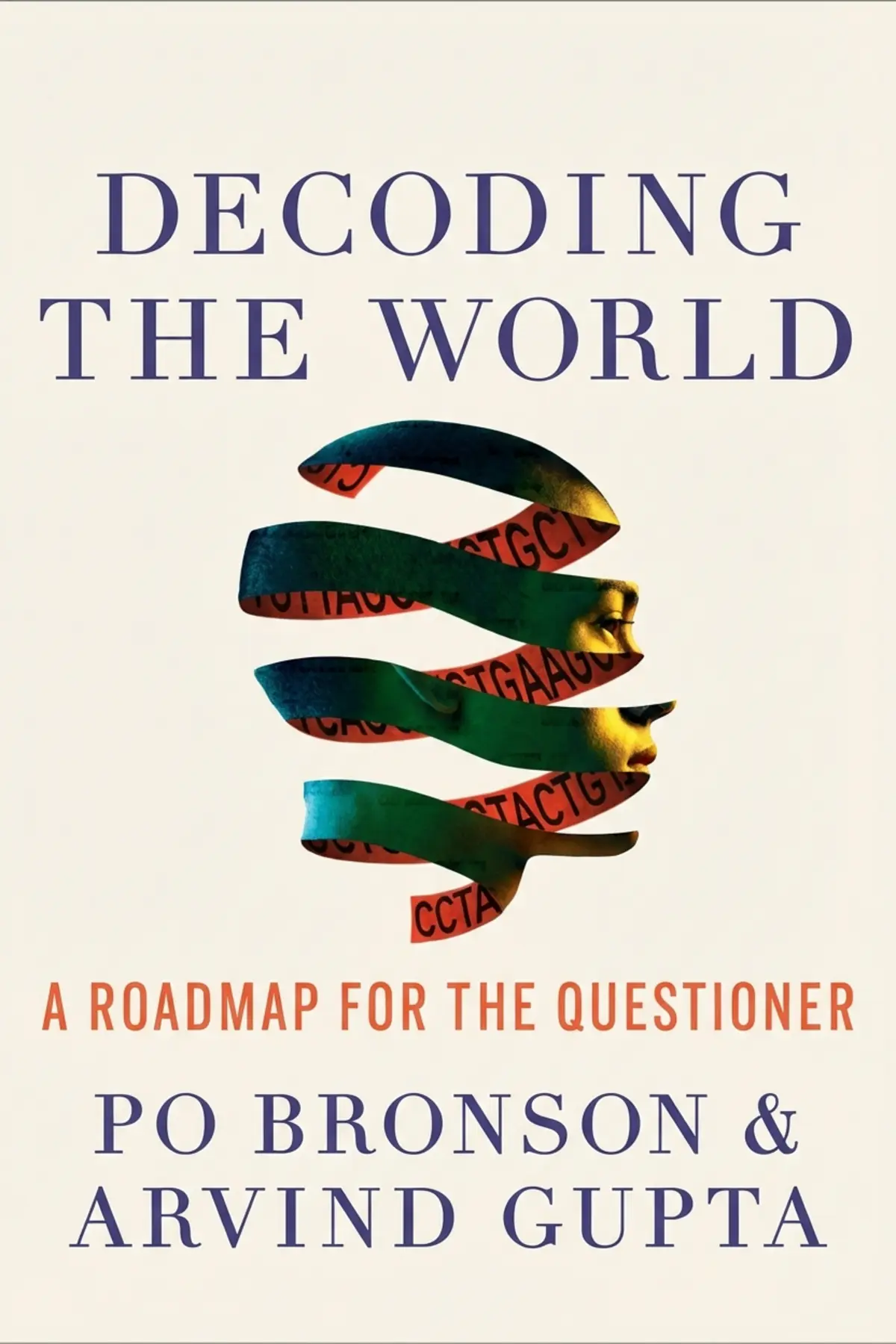
Headlines about pandemics, cancer, melting ice and artificial intelligence can leave anyone feeling like a spectator to a future they cannot read. In Decoding the World, Po Bronson and Arvind Gupta, the friends who ran the biotech investment firm IndieBio, argue that how we respond also matters: we tend either to stall or to leap to worst-case extremes. Their first lesson comes from the pandemic itself. Bats carry many viruses but rarely pass them to people, unless humans destroy their forests and wetlands and put them under stress.
That pattern runs through the whole book. The great problems of our time are linked, science is already producing answers to many of them, and the outcome depends on whether we resist inertia and fear and choose to act. Along the way come bees rescued by a hormone cocktail, a snail given another snail’s memory and a company chasing the perfect blue, plus a sharper way to read the next frightening headline.
1 min 40 sec
A chess game with five sides, and one player who also moves the other pieces. That picture of the future raises a hard question for anyone hoping a small team can change anything at all.
1 min 41 sec
Bats carry many viruses yet rarely make people sick. Something has to change before they do, and the trigger points uncomfortably close to home for all of us.
1 min 49 sec
A startup found a way to make failing bee colonies healthy again, and the people who stood to gain most barely reacted. Their indifference mirrors a much larger failure involving coal and climate.
1 min 55 sec
Mention gene editing and many people picture designer babies at once. A kidney treatment and a library catalog suggest that reflex points our worry at the wrong danger.
1 min 47 sec
A snail received another snail’s memory, and a familiar food is being turned into an anti-aging drug. These findings hint at how little we still understand about the body we live in.
1 min 48 sec
Bacteria that make electricity or turn food waste into fuel sound like magic. A short list of ingredients explains them, and it also turns climate change into a job of moving things.
1 min 50 sec
Biotech investors spending money on a color sounds odd. The reason reaches back to medieval luxury and colonial exploitation, and it shows why social change keeps catching everyone off guard.
1 min 07 sec
Decoding the World adds up to a call for a particular kind of attention. The authors see the planet and the body as one system with the same weak points. Both depend on a stable core temperature: a two-degree rise in your own body would worry you at once, and they argue a two-degree rise for the Earth deserves the same alarm. Both depend on microbes we barely understand. Just as the Green New Deal sets out a plan for the planet, they suggest a New Deal for our bodies, starting with cutting the sugar we pollute ourselves with, the way we must cut carbon.
Some futures remain far off. AI still lacks the common sense of a four-year-old. And there is something in us, call it the soul, that no scientist will find by searching a brain; the authors locate it in what we choose to do.
So when a headline frightens you, check whether you are picturing the worst extreme or looking at what is actually happening. When a good fix sits unused, ask what keeps the old way rolling. Science keeps telling us more about what we are. What we do with that knowledge is still our choice.
Pandemics, cancer, melting glaciers, the rise of China, artificial intelligence and genetic engineering: the forces shaping the future can feel too big and too tangled to follow. Po Bronson and Arvind Gupta, the friends who led the San Francisco biotech investor IndieBio, have spent years funding startups aimed at exactly those problems, and they write from inside that work. Their argument is that these problems are connected. Stressed bats lie behind the pandemic, and the planet and the body share the same weak points. They also argue that science is already producing real answers. What holds progress back is often our own reaction. Inertia leaves a working fix for dying bees unused and keeps money-losing coal plants running. What they call the Warp-Speed Impulse turns every new technology into a nightmare. Readers meet a kidney treatment built with CRISPR, a memory moved between snails, an anti-aging drug based on mother's milk, a plan to turn carbon into rock and a company chasing a cleaner blue dye. The result is a clearer way to read alarming news and a case for choosing to act on what science reveals.
Professionals who feel overwhelmed by news about pandemics, climate and AI and want a clearer way to read it.
Founders and investors curious how biotech startups tackle problems from cancer to carbon capture.
Curious readers who want genetics and the microbe world explained through real projects.
Arvind Gupta founded IndieBio, a biotechnology company based in San Francisco, and Po Bronson serves as its managing director. Bronson is an American journalist and author whose work has appeared in Time, The New York Times, The Wall Street Journal and on NPR's Morning Edition. His book What Should I Do with My Life? reached number one on the New York Times bestseller list. With Ashley Merryman he wrote NurtureShock, and their journalism won national awards, including the PEN USA Award for Literary Journalism. The authors present this book as the first of their convergence trilogy.
Listeners find the book to be an excellent source of information. They value the high quality of the writing, with one listener noting it is an essential read for the modern age.
Ever wonder how the future actually gets built? Bronson and Gupta provide a fascinating look behind the curtain of biotechnology and venture capital. While some chapters are definitely dense, the optimism here is infectious. I particularly loved the breakdown of RNA and how it's being used to tackle everything from viruses to food security. It’s a must-read for anyone who feels overwhelmed by the negative headlines we see every day. The authors have a way of taking complex biological concepts and making them feel like tools for positive change. Truth is, we need more thinkers who aren't afraid to be bold about science.
Show moreWow, this book really shifted my perspective on the intersection of biology and our global future. The way the authors break down the "War on Truth" alongside genetic breakthroughs is nothing short of brilliant. I often had to pause and re-read sections just to wrap my head around the scale of the innovations they are describing. It’s not just about the science; it’s about the philosophy of how we perceive risk and progress in an era of rapid change. Some might find the tone a bit too "Silicon Valley," but the underlying data and the clear metaphors make the complex subjects accessible. Decoding the World is an ambitious project that mostly succeeds in making the future feel like a place we want to live in.
Show moreDecoding the World offers a rare, optimistic glimpse into the minds of people trying to solve the planet's messiest problems. Instead of the usual doom and gloom associated with climate change and global health, Bronson and Gupta provide actionable ideas and a sense of agency. The prose is incredibly readable, avoiding the dense jargon that usually plagues science books of this caliber. I loved the exploration of lab-grown food and the potential for "decarbonizing our diets" as a real solution. It’s a book that encourages you to keep an open mind to possibilities that seemed like magic only a few years ago. Truly an excellent introduction to the wild frontier of bioengineering for any curious reader.
Show moreAs someone who follows science news religiously, this was a refreshing way to digest complex global issues. The format is unique; they take a current headline and use it as a springboard into deep-dive discussions on things like genetic engineering and the climate crisis. I appreciated the chapter on the COVID-19 vaccine development because it highlighted the speed of innovation when humanity is truly pressed. Some parts feel a bit scattered, jumping from Bond villains to illegal sand trading, which can make it hard to find a through-line. However, Gupta and Bronson are clearly experts in their field. Their prose is clear enough for a layperson while remaining intellectually stimulating for those with a background in bioengineering.
Show moreFinally got around to reading this, and I’m struck by how it bridges the gap between lab science and venture capital. The authors don't just talk about theories; they talk about the actual companies and people trying to scale these solutions through IndieBio. It’s fascinating to see how they view the world as a series of problems waiting for a biological hack. While I wasn't a fan of the casual text message interludes—they felt a bit forced—the core information about lab-grown meat and climate mitigation is top-notch. It left me feeling a lot more hopeful about the next decade. If you like the style of magazines like Wired or Popular Science, you’ll likely find this right up your alley.
Show moreAfter hearing about the work Arvind Gupta has done with biotechnology startups, I was eager to see his take on our planetary challenges. This book delivered a high-energy look at how bioengineering might solve the climate crisis and improve human longevity. The writing style is punchy and direct, which helps when they are explaining something as complicated as CRISPR or AI-driven genetics. I did find the "Bond villain" comparisons a bit strange, but they served their purpose in making the ethical stakes clear. It’s a very "now" book that feels relevant to every headline we're seeing in the news today. It’s definitely not for everyone, but if you’re a tech-optimist, you’ll find plenty of fuel for your fire here.
Show moreTo be fair, I wasn't sure if I'd like the conversational style and the text message headers, but they actually grew on me as I got deeper into the book. It makes the authors feel more like human beings rather than just distant experts lecturing from an ivory tower. The scope of the material is incredibly broad—covering everything from COVID vaccines to cryptocurrency—which keeps the pace moving quickly. I would have liked a bit more proof for some of their more "out there" opinions, but the sheer volume of ideas makes up for it. It’s a smorgasbord of biotechnology and social commentary that hits more often than it misses. Highly recommended for fans of speculative non-fiction.
Show moreThe chapter on healthcare reform was a bit of a slog, but the rest of the book generally holds your attention with its fast-paced ideas. I went into this expecting a straightforward science book, but it’s much more of an "opinion book" focused on how technology might save us. Bronson and Gupta trade essays back and forth, which creates a conversational tone that sometimes works and sometimes feels a bit condescending. I found the section on "DNA hacking" to be the most compelling part of the entire experience. It’s a smorgasbord of topics, and honestly, you might be better off reading the chapters that interest you most rather than going cover-to-cover. It’s an okay read if you want a broad overview of the tech frontier.
Show moreThis book is a bit of a mixed bag for me, depending on which chapter I was currently reading. At its best, it offers mind-blowing insights into RNA and the future of medicine that feel like they belong in a sci-fi novel. At its worst, it feels like a collection of disjointed blog posts that don't quite cohere into a central argument. I found the constant switching between Bronson and Gupta to be a bit jarring at times, though their distinct voices do eventually become familiar. The authors are clearly brilliant, but they sometimes veer into topics where their expertise feels a bit thin, like universal healthcare. It’s a decent choice if you want to stay updated on current tech trends, but don't expect a deep academic study.
Show moreNot what I expected when I picked this up based on the sleek cover and the promising subtitle. While I appreciate the work IndieBio does, this book felt more like a series of disjointed op-eds than a cohesive scientific exploration. The "tech-bro" vibe is strong here, often feeling like I was being lectured by two guys at a cocktail party who think they have the solution to every global problem. I found the inclusion of their personal text messages to be quite gimmicky and distracting from the actual content. To be fair, some of the biotechnology insights are interesting, but they are buried under layers of personal anecdotes and unverified opinions. It just lacked the academic rigor I was looking for in a science book.
Show morePo Bronson and Arvind Gupta argue that the biggest forces shaping the future, including pandemics, climate change, genetics, artificial intelligence and China’s rise, are connected. Drawing on their work at the biotech investor IndieBio, they show science already producing answers, from healthier bees to carbon turned into rock. What holds progress back is usually human reaction: inertia that keeps old habits running and fear that imagines every new technology at its worst.
It is the authors’ name for our habit of picturing any trend pushed to its most extreme outcome. Struggling bees become a world without bees, and gene editing becomes designer babies. The authors counter that genome editing is tightly regulated, and they point to an IndieBio geneticist using CRISPR to help the body accept a transplanted kidney, a one-time treatment that leaves a patient’s genome unchanged.
Borrowing loosely from Newton’s first law, they use inertia for the tendency of people and institutions to keep doing what they already do. Their examples include beekeepers ignoring Beeflow’s proven fix for sick colonies and coal plants that keep running at a loss only to pay off debt. They argue that overcoming this stillness is necessary if we are going to save the planet.
The book suggests a few habits of thought. When a crisis appears, trace it back to the human pressure behind it, as with bats stressed by habitat loss. When a working solution goes unused, look for what keeps the old way going. When a technology scares you, ask what it is really being used for today, and frame large problems as matter that needs moving, as with carbon from air to soil.
J. Craig Venter

Yuval Noah Harari

Carl Zimmer


Bill Bryson


Jeff Hawkins

Kai-Fu Lee


AUDIO SUMMARY AVAILABLE
Get the key ideas from Decoding the World by Po Bronson, plus 5,000+ more nonfiction titles.









