

13 min 57 sec
Available in: English
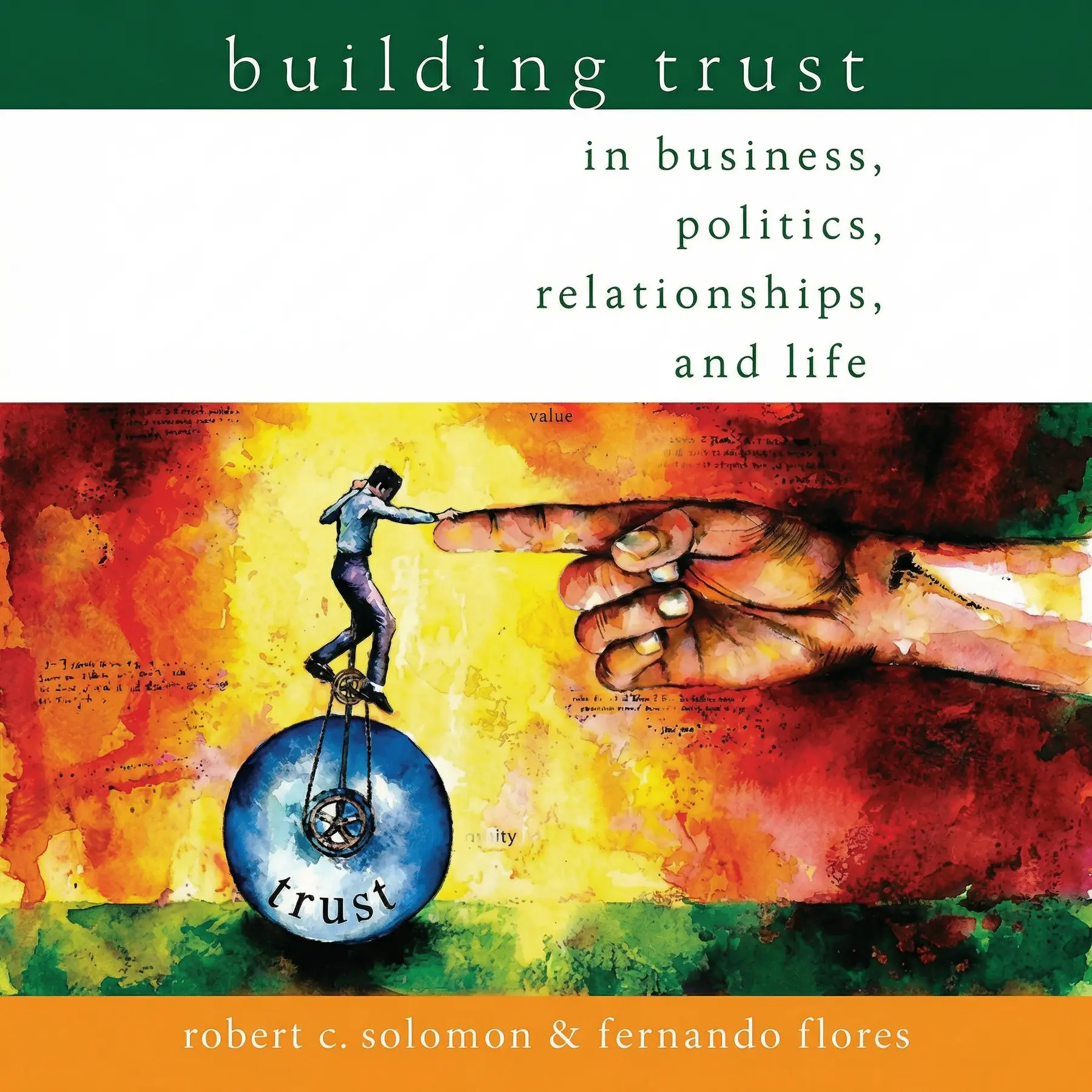
Building Trust: In Business, Politics, Relationships, and Life
Shows why trust is a deliberate practice instead of a feeling, and how to give it first, hold it alongside doubt and repair it after a breach, at work, at home and in public life.
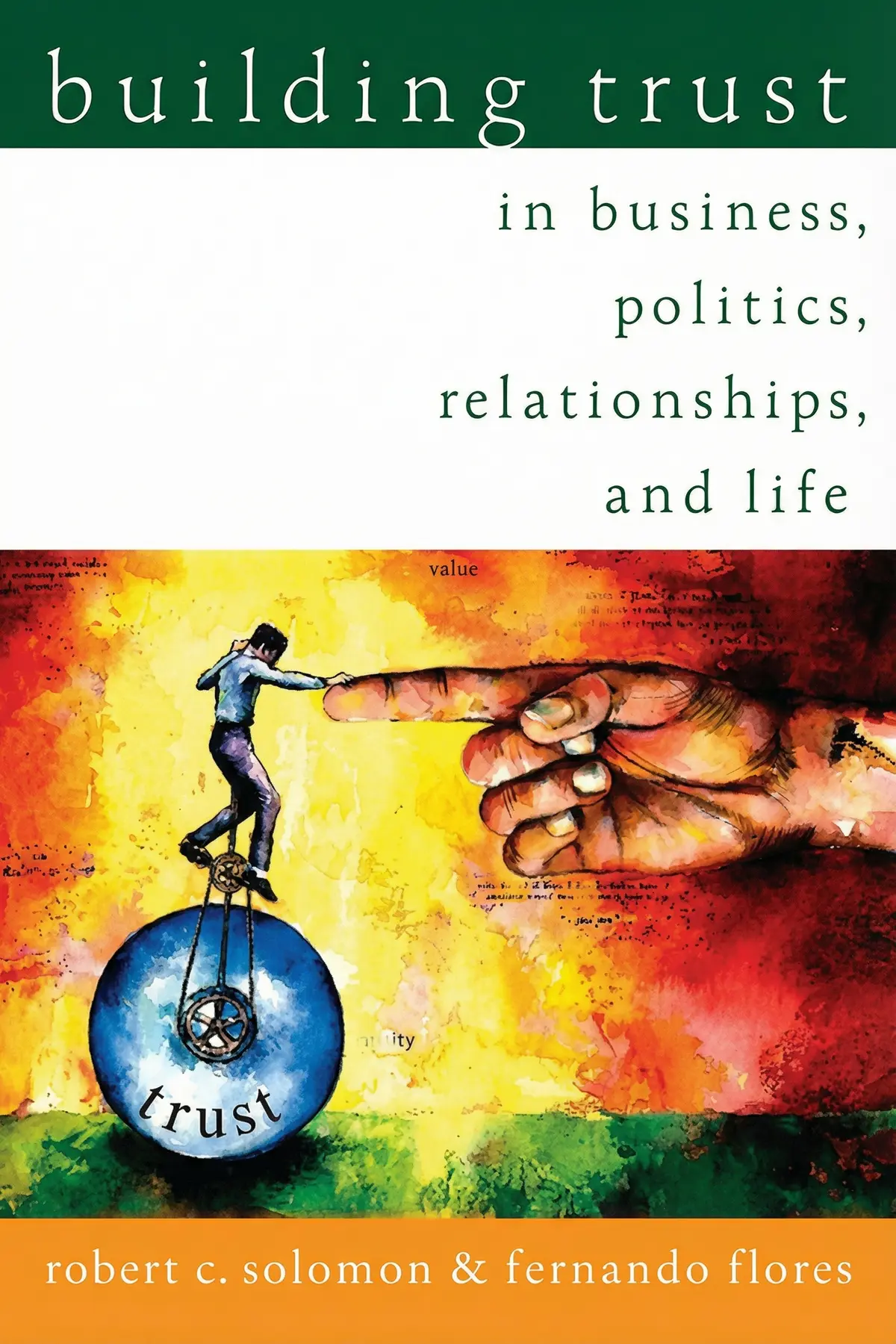
Table of Content
1. Introduction
1 min 07 sec
If you manage people, lead a project or share a home, you probably treat trust as something that is either there or not, and you wait for others to earn it. In Building Trust, philosopher Robert C. Solomon and Chilean engineer and politician Fernando Flores argue that trust is something you do, not something you feel, and that it often has to be given before it can be deserved. Waiting for proof, they suggest, tends to produce the very failures you feared.
Their case is simple to state and hard to live. Trust is a deliberate choice, made with open eyes about risk, kept alive through clear words and steady action, and repaired by facing breaches instead of hiding them. Fear and tight control breed the distrust they are meant to prevent.
Through a manager who gave up on a new hire, an executive who backed a struggling one and two banks that read one contract very differently, the book offers a way to build trust on purpose, at work and at home.
2. Swap fear for trust to win real commitment
1 min 54 sec
A workplace where nobody makes mistakes can look like a well-run one. The former head of Intel thought it signaled the opposite, and the reason exposes a hidden cost that fear-based management keeps paying.
3. Say your expectations out loud
1 min 56 sec
A manager hires someone promising, watches the deadlines slip and starts planning her exit. Nobody in the story lied or slacked off, which makes the real cause of the breakdown all the more uncomfortable to face.
4. Give trust first and responsibility follows
1 min 49 sec
An inexperienced employee makes early mistakes on a high-stakes project, more than enough reason to pull him off it. His boss made a different call, and it changes how you might think about earning trust.
5. Trust with your eyes open, doubts included
2 min 00 sec
A wife suspects her husband of being unfaithful, and she chooses a response most people would never consider. Her choice reveals a kind of trust that grows stronger precisely because it refuses to look away.
6. Confident leaders give others room to lead
2 min 00 sec
Micromanagement usually looks like a verdict on the team. The authors trace it to a gap inside the manager instead, and closing that gap changes what everyone around them is willing to try.
7. Repair broken trust by naming the breach
1 min 47 sec
When Japan’s economy collapsed, a Japanese bank ignored the terms of its contract with an American partner. The American lawyers were outraged. The Japanese bankers believed they had done the trustworthy thing, and the authors take that seriously.
8. Conclusion
1 min 24 sec
What Solomon and Flores offer, in the end, is a change of verb. Trust stops being something you have or lack and becomes something you do, every day, with your eyes open. Fear and control promise safety and deliver compliance, cynicism and a slow spiral of suspicion. Deliberate trust carries risk, yet it is the only ground on which people take initiative, speak honestly and commit to shared goals.
Seen that way, David and Charlotte faced the same problem: a new person who stumbled. One assumed trust would take care of itself, never spelled out what he wanted, and then fell back on micromanagement when results slipped. The other kept faith, set clear expectations and got the employee she hoped for.
The practice can start small. Tell the next person you rely on exactly what you expect, instead of hoping they guess. When doubt arrives, decide consciously whether you still choose to trust, and act on that choice. And when trust breaks, on either side, bring it into the open and do the repair work, since a breach faced honestly can leave a relationship sturdier than one that was never tested.
Trust that waits for certainty never begins. Trust given with care is usually returned.
About this book
What is this book about?
Most people treat trust as something that is simply there or missing, and they wait for others to earn it. Robert C. Solomon and Fernando Flores argue that this habit is where trust goes wrong. Left alone, trust fades, and workplaces and relationships settle into polite silence while real problems stay unspoken. The authors, a philosopher and a Chilean engineer and politician, describe trust as something people do. They contrast fear-driven control, which wins compliance and loses commitment, with authentic trust: a conscious choice made with the risks in full view. Through cases such as a manager who gave up on a new hire, an executive who backed a struggling one and two banks that read the same contract in opposite ways, they show how trust is given, kept and rebuilt. Readers learn to state expectations openly, extend trust before they feel certain, start from self-trust, lead with transparency and repair a breach so that the relationship can come out stronger.
Book Information
Who it's for
Managers tempted to micromanage
Managers and team leads who catch themselves micromanaging or waiting for new hires to prove themselves.
Repairing work relationships
Professionals rebuilding a working relationship after a broken promise, a missed deadline or a public mistake.
Couples and parents
Partners and parents who want to keep trust alive at home when doubts start to surface.
About the Author
Robert C. Solomon
Robert C. Solomon was an American philosopher who taught at the University of Texas at Austin from 1972 until his death in 2007, where he held a named chair in philosophy and business and won several teaching awards. He wrote on emotions, love, existentialism and business ethics. Fernando Flores is a Chilean engineer, philosopher, entrepreneur and politician who served as a cabinet minister under Salvador Allende, sat as a senator from 2001 to 2009 and was named head of Chile's National Innovation Council for Competitiveness in 2010.
Ratings & Reviews
Ratings at a glance
What people think
Listeners find the text accessible and value the discussions regarding trust, including one who highlights how it provides a sense of peace. The book also delivers clear insights into the significance of trust and offers deep nuances that are helpful for cultivating relationships. Furthermore, listeners regard the material as highly worthwhile.
Top reviews
Rotjanee
This book completely reframes trust from a passive feeling into a rigorous social practice. Solomon and Flores argue that 'authentic trust' isn't naive; it is a conscious choice made with full awareness that betrayal is possible. I found the distinction between simple, unquestioning trust and the mature version we need in business incredibly helpful. Instead of treating trust as a fragile antique that breaks once, they show it as something dynamic that requires constant work. The prose is a bit academic, but the depth of insight into how we 'attune' to others' concerns is worth the effort. It’s a short read at 150 pages, but it packs a punch for anyone trying to lead with more than just fear and control.
Show moreNatchaya
Finally got around to this classic and it brought me a surprising amount of peace. We often treat trust as something that is either there or it isn't, but this book argues it is a 'mood' we can cultivate. I loved the idea that trust is a gift you offer before it is earned—that’s a radical thought in today’s cynical world. By focusing on 'authentic trust,' the authors give you permission to be both vulnerable and wise. The chapter on self-trust was a highlight for me. If you don't trust your own judgment, you'll always be micromanaging others out of fear. It’s a brief, moving argument for a better way to live and work.
Show moreAkira
Look, most leadership books are just collections of 'hacks,' but this is a deep meditation on what it means to be human in a community. It treats trust as the foundation of everything—from your marriage to the global stock market. The authors don't promise it's easy; they actually emphasize how difficult and emotionally charged rebuilding broken trust is. I found the section on self-trust especially convicting. When we lack confidence, we create systems of suspicion that stifle everyone around us. This book provides a rich vocabulary for talking about these dynamics. It is a highly valuable resource for anyone who wants to move beyond compliance and toward genuine commitment in their relationships.
Show moreYui
Picked this up because I was tired of the usual HR fluff about 'teamwork' and wanted something with more substance. Solomon and Flores deliver a philosophical yet practical look at how trust functions as the bedrock of the global economy. I particularly liked the section on Andy Grove and the idea that a lack of trust actually stifles innovation. When employees are afraid to make mistakes, they stop trying. The book is easy to read in a weekend, which I appreciated. My only gripe is that it gets repetitive in the middle sections. To be fair, the core message is vital: trust is an action, not just a sentiment. It has certainly changed how I approach my team.
Show moreSoontorn
As a philosophy buff, I loved seeing Heidegger's concepts of 'care' and 'attunement' applied to the modern workplace. Trust isn't just about contracts; it’s about sharing in another person's concerns. The authors do a great job of explaining why 'congenial hypocrisy'—pretending things are fine when trust is gone—is so damaging to organizations. While the writing style is a bit dry and academic, the distinctions between 'blind trust' and 'authentic trust' are genuinely useful. You start to see trust as a choice you make every day. I deducted one star because the examples involving international banking felt a little dated and lacked cultural depth, but the core logic remains incredibly solid.
Show moreAndrei
The takeaway here is that trust is a gamble you have to take before you see the payoff. I've read plenty of leadership books, but few address the emotional weight of betrayal as an inevitable part of the process. Solomon and Flores argue that if you aren't open to the possibility of being let down, you aren't really trusting. That’s a tough pill to swallow but feels authentic. The book provides clear explanations for why communication breaks down and how to start the repair process through accountability. It’s a bit repetitive in the first two parts, and they could have used fewer anecdotes about fictional managers, but the underlying philosophy is excellent.
Show morePruet
Ever wonder why some people are naturally suspicious while others are open books? The authors lean heavily on Erik Erikson’s developmental theories to explain this, suggesting our childhood caregivers set our trust blueprints. While interesting, it felt a bit deterministic and ignored how much adults can grow through new experiences. I appreciated the critiques of fear-driven leadership, especially the references to Machiavelli’s legacy in modern offices. However, the solutions offered—like 'be more transparent'—felt like slogans I've heard a thousand times before. It’s a decent meditation on the subject, but don't expect a step-by-step manual. The stories about managers like David and Alex felt a bit too neat for the messy reality of corporate politics.
Show morePhichai
To be fair, Solomon and Flores make a very clear distinction between trust and trustworthiness that most people miss. One is an action you take, the other is a quality you build. That alone was worth the read. However, I found the book's dismissal of fear-based systems a bit one-sided. In some high-stakes industries, strict control and 'command-and-control' structures exist for legal and safety reasons, not just because a leader is insecure. The authors tend to moralize trust, making it seem like the only enlightened choice while demonizing self-protection. It's a bit too idealistic for my taste, though the insights into how suspicion becomes a self-fulfilling prophecy were quite sharp.
Show morePrinya
Frankly, 150 pages felt simultaneously too short and yet somehow too long. The authors repeat their main points about integrity and follow-through so many times that I started skimming by chapter four. The section on childhood development felt out of place and a bit reductive for a book that is otherwise about professional and political life. That said, I did appreciate the discussion on 'cynicism' as a socially acceptable form of distrust. It helped me realize how much negativity I was bringing to my own office. There’s some good fruit here, but you have to peel through a lot of academic jargon and repetitive moralizing to get to it.
Show moreTawee
Not gonna lie, I struggled to find the 'transformative' value here that others mention. The book is basically a long-form essay stretched into a small volume. It boils down to a few basic themes: companies should trust people more, and being trustworthy is good. The hypothetical scenarios, like the story of Charlotte and Rahul, felt like oversimplified parables that didn't account for real-world risks. What happens when that trust is actually exploited? The authors gloss over the fallout. It’s full of meaningless sentences that sound deep but offer little practical guidance for someone in a truly toxic environment. If you want a blog post on why trust matters, this is fine, but it’s not a deep dive.
Show moreQuestions about this book
What is the main idea of Building Trust by Solomon and Flores?
The authors argue that trust is an active practice, not a feeling that is simply present or missing. It has to be chosen deliberately, often before the other person has proved anything, and kept alive through clear communication and consistent action. Fear and tight control, which many organizations rely on, produce compliance and suspicion instead of commitment. When trust breaks, it can be rebuilt through open acknowledgment and real repair.
What is authentic trust?
Authentic trust is trust chosen with the risks in full view. The authors contrast it with simple trust, which is automatic and untested, and blind trust, which ignores warning signs. Their example is a woman who suspects her husband of infidelity yet keeps acting with trust, handling the doubt with patience and discipline. Because authentic trust has already faced the possibility of disappointment, it adapts under pressure and grows stronger with experience.
Should you trust people before they earn it?
Often, yes, according to Solomon and Flores. They separate trusting, which is a decision, from trustworthiness, which is a quality shown over time. In the book, an executive named Charlotte gives an inexperienced employee, Rahul, an important project, keeps backing him through early mistakes and sets clear expectations. He grows into the role. The lesson is that trust given with clear standards helps create the responsibility it hopes for.
How do you rebuild trust after it has been broken?
The authors say trust can survive mistakes as long as people take responsibility. Acknowledge the breach openly, take concrete steps to repair it and keep those changes going over time. Ignoring a betrayal or dismissing someone’s concern weakens trust further. Handled honestly, a breach can even leave trust deeper than before, because both sides have seen the relationship withstand a real test.
Who should read Building Trust?
It suits managers who rely too heavily on control, leaders trying to build teams that speak up and take initiative, and anyone repairing a damaged relationship at work or at home. Its cases, from a manager who never stated his expectations to two banks with opposite views of a contract, make abstract ideas about trust concrete enough to use in daily decisions.
Featured in
Readers also enjoyed




A Year with Peter Drucker: 52 Weeks of Coaching for Leadership Effectiveness
Joseph A. Maciariello




A Guide to the Good Life: The Ancient Art of Stoic Joy
William B. Irvine

Acting with Power: Why We Are More Powerful Than We Believe
Deborah Gruenfeld
AUDIO SUMMARY AVAILABLE
Listen to Building Trust in 15 minutes
Get the key ideas from Building Trust by Robert C. Solomon, plus 5,000+ more nonfiction titles.
- 5,000+ titles
- Listen as much as you want
- 7-day free trial
- Cancel anytime









