
14 min 14 sec
Available in: English
Blue Ocean Shift: Beyond Competing – Proven Steps to Inspire Confidence and Seize New Growth
A step-by-step method for leaving crowded, price-driven markets behind. Change how you see your industry, bring your team along fairly, and use five practical tools to design an offer nobody else is competing on.
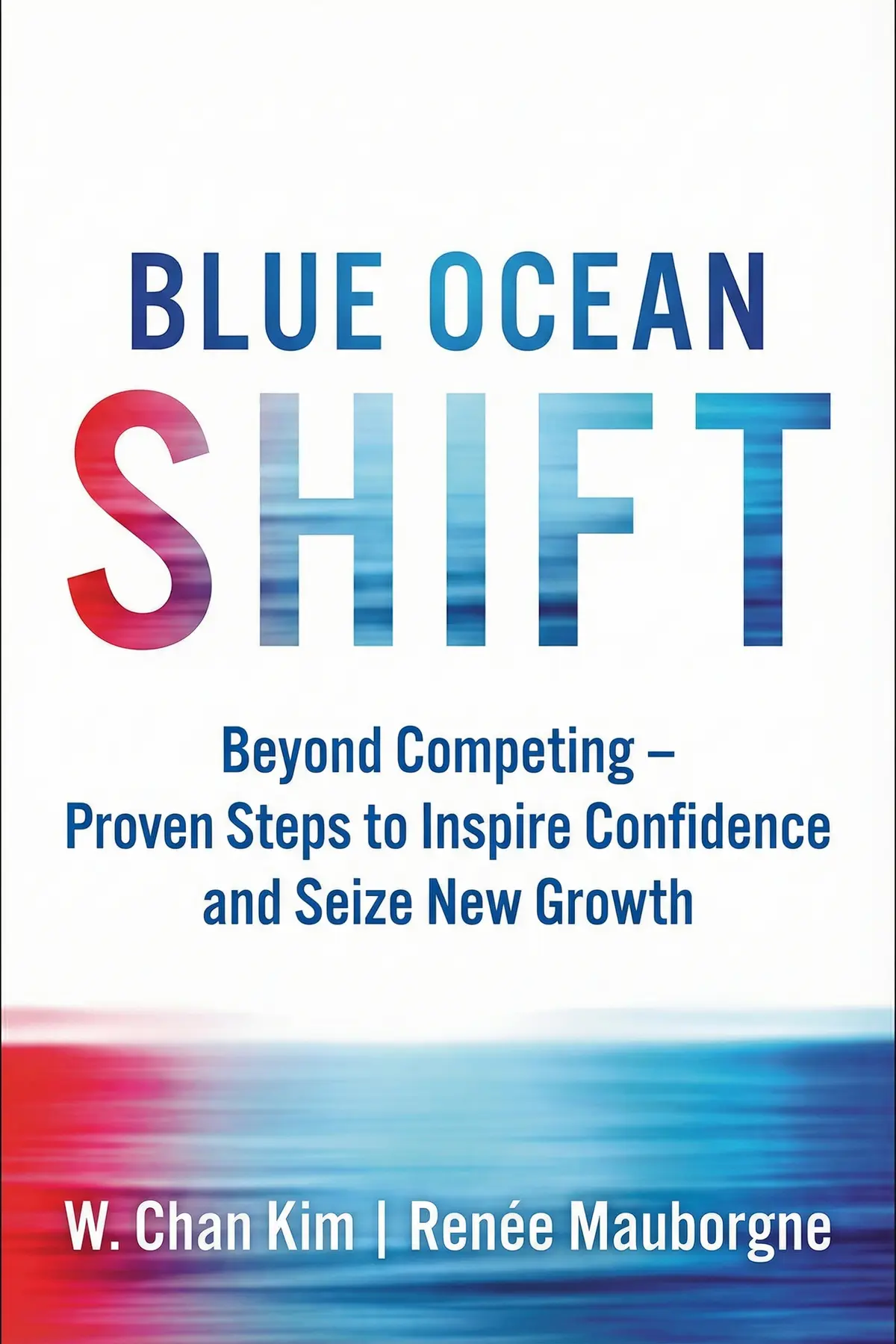
Table of Content
1. Introduction
48 sec
If your company spends its energy matching rivals feature for feature and price for price, you are swimming in what W. Chan Kim and Renée Mauborgne call a red ocean. In Blue Ocean Shift, the two INSEAD strategy professors show how a French appliance maker found a way out simply by refusing to accept that fries need liters of oil.
Leaving crowded water, they argue, is a repeatable process, not a lucky break. It rests on three things: a wider way of seeing your industry, real respect for the fears of the people who must make the change, and practical tools that turn insight into a new offer. Follow the method and you can judge honestly where your products stand, find the frustrations that keep buyers away, and design something rivals are not even competing on.
2. Choose a third road beyond price and quality
1 min 27 sec
Strategy usually means picking between being better or being cheaper. A French maker of small appliances found a third option by questioning one assumption that no one in its industry had ever thought to challenge.
3. Make rivals irrelevant instead of beating them
1 min 25 sec
Some 600 cancer charities compete for donors in a single city. One British charity stepped out of that race entirely, and its method came down to a red clown nose.
4. Bring your people across without forcing them
1 min 27 sec
The best analysis fails when the team carrying it out is afraid. The authors name three conditions that turn a frightening overhaul into something people believe in and choose for themselves.
5. See honestly where your products stand today
1 min 31 sec
Most companies believe their offerings are more original than they are. Two straightforward drawings can show a whole team how exposed the business really is.
6. Find the hidden pains that keep buyers away
1 min 28 sec
Wine makes up a surprisingly small share of alcohol sales in the United States. The reasons are hiding in ordinary moments of buying and drinking, and a simple grid can bring them out.
7. Search six places your rivals ignore
1 min 36 sec
Teams hunting for growth usually stare at their own customers. In Britain’s crowded kettle market, one company found an opening by looking at what happened before the tea was even made.
8. Cut, raise and create your way out
1 min 43 sec
Removing the front desk sounds like the worst idea a luxury hotel could have. One chain did it on purpose, and the trade it made shows how to design an offer that is cheaper and better at once.
9. Pick the winning option together, in one room
1 min 35 sec
Good strategies often die in a meeting where one senior voice decides. The authors replace that meeting with a fair, posters on the walls and a vote anyone in the room can cast.
10. Conclusion
1 min 14 sec
What Kim and Mauborgne offer is a way to turn escaping competition into ordinary, repeatable work. An appliance maker questioned all that frying oil, a charity handed out red noses, a hotel threw away its front desk. Each looks like inspiration from the outside. Underneath, each is the same move: dropping an assumption the whole industry shared and building around what buyers actually struggle with.
The method also treats people as part of the strategy. A shift ordered from the top meets fear. A shift people discover for themselves, in small steps and through a process they can see is fair, gets carried out.
You can begin this week. Sketch your products on a pioneer-migrator-settler map and look hard at how many circles sit in the bottom row. Draw a strategy canvas against your strongest rival and see whether the two lines nearly overlap. Then walk one product through the 36 cells of the buyer utility map and circle the pain nobody in your industry has bothered to remove.
The open water is rarely far off. It usually lies just past the assumption everyone around you has stopped questioning.
About this book
What is this book about?
Most organizations fight in what W. Chan Kim and Renée Mauborgne call red oceans: markets so crowded that every gain comes at a rival's expense, usually through better features or lower prices. In Blue Ocean Shift, the two INSEAD strategy professors argue that a third option exists. A company can move into a market that nobody occupies yet, and that move is a process anyone can follow. The authors build their method on three parts. The first is a wider perspective that treats industry rules as changeable. The second is humanness, a way of respecting the fears of the people who must carry out the change. The third is a set of market-creating tools: a map of where your products stand, a canvas comparing you with your strongest rival, a grid of hidden buyer frustrations, six paths for spotting new opportunities and four questions for designing the new offer. The examples run from a French appliance maker that cooked fries with a tablespoon of oil to a British charity built on clown noses and a hotel chain that removed its front desk. Readers get a practical sequence they can run with their own team, ending in a vote among invited leaders on the best option.
Book Information
Who it's for
Stuck in price wars
Founders and managers stuck in price wars with look-alike competitors.
Strategy and innovation leads
Strategy and innovation leads who need a workshop-ready process their teams will trust.
Leads wanting new ideas
Team leads who want new ideas without forcing change on people from above.
About the Author
W. Chan Kim
W. Chan Kim and Renée Mauborgne are professors of strategy at INSEAD and co-directors of its Blue Ocean Strategy Institute in Fontainebleau, France. Together they wrote Blue Ocean Strategy, published in 2005, and in 2019 Thinkers50 ranked them the most influential management thinkers in the world, with Mauborgne the first woman to take the top spot. Both are Fellows of the World Economic Forum and co-founders of the Blue Ocean Global Network. Mauborgne also served on President Barack Obama's Board of Advisors on Historically Black Colleges and Universities.
Ratings & Reviews
Ratings at a glance

What people think
Listeners find this work to be a superior resource for entrepreneurs, praising its interesting narrative and insightful real-world examples. Additionally, they are impressed by the functional strategy, systematic instructions, and straightforward clarity. It also functions as a perfect supplement to the Blue Ocean Studio, and listeners feel it is a valuable purchase.
Top reviews
Fatima
Picked this up on a whim for my startup and was immediately struck by the clarity of the case studies. The way they break down the shift process into five distinct steps makes a daunting strategic move feel achievable for any organization. I particularly appreciated the 'humanness' approach which focuses on building confidence within the team during times of transition. Frankly, many business books ignore the emotional hurdles of change, but Kim and Mauborgne put it front and center. The specific examples provided, like the transformation of a traditional industry, were both illuminating and highly engaging. This book is well worth the investment for anyone serious about creating new market space.
Show moreWoravit
Ever wonder how you can innovate in a market as basic and boring as toilet paper? The case study on Kimberly-Clark Brazil was absolutely fascinating and showed that no product is too 'standard' for a blue ocean shift. The authors explain how to run a 'Blue Ocean Fair' to get the entire company aligned behind a new strategic direction. This practical approach is what sets the book apart from theoretical academic papers. In my experience, getting buy-in from skeptical employees is the hardest part of any shift. By following the 'humanness' steps, we were able to build the necessary confidence to launch our new service line. It really is an essential guide for modern leaders.
Show moreWin
Look, if you are tired of fighting for scraps in a bloody market, you need this systematic process immediately. This book transcends simple entrepreneurship and offers valuable insights for those in the public sector or nonprofit world as well. The structure is incredibly neat, with graphs and tables that enhance your understanding of every strategic move. I found the section on 'pain points' particularly eye-opening because it forced us to experience our service as a user would. It took me a while to get through it during my spare time, but the depth of knowledge is undeniable. This is a masterpiece of strategy that every manager should have on their desk.
Show moreMoon
As someone who struggled to turn the original theory into actual results, this sequel felt like a necessary roadmap for my team. The authors provide a granular, step-by-step execution plan that moves beyond high-level metaphors into practical application. I found the 'Pioneer-Settler-Migrator' map especially useful for auditing our current product portfolio against the competition. To be fair, the writing can be a bit dry in the middle chapters, but the actionable tools like the Strategy Canvas make up for the slower pace. We are currently using the 'buyer utility map' to identify pain points we previously ignored. It is an excellent read for business owners looking to move beyond bloody red ocean competition.
Show moreApichat
Finally got around to finishing this, and the emphasis on nondisruptive creation is a total game changer for market strategy. I noticed some strong parallels with Peter Thiel’s thoughts on monopolies, but this provides a much more structured framework for implementation. The book serves as a great companion to the Blue Ocean Studio tools and offers a systematic process to escape cutthroat markets. Personally, I think the methodology is proven by the diverse range of industries covered, from nonprofits to government agencies. My only gripe is that it could have been sixty pages shorter without losing any of its core impact. Still, the step-by-step guidance is superior to most strategy books on the market.
Show moreMay
In my experience, most business books are 90% fluff, but this one actually provides a granular execution plan that teams can follow. The distinction between 'red' and 'blue' oceans is clearly defined, helping us realize how much energy we were wasting on competitors. Using the Strategy Canvas helped our leadership team visualize our industry's standard offerings versus our unique value proposition. I love how the book emphasizes involving all departments, not just the heads of strategy or the executive suite. It ensures that everyone feels valued and understands their specific contribution to the shift. This is a solid, easy-to-understand manual for organizational change that produces real, tangible results.
Show moreNim
The chapter on the 'Blue Ocean Fair' alone makes this worth the investment for any organizational leader. It provides a clear way to pitch new ideas to management and potential customers without the usual friction of corporate politics. While some parts of the book feel like a replica of previous ideas, the focus on implementation makes it a better purchase than the original. Not gonna lie, I wish there were more concise bullet-point summaries at the end of each long chapter. It would have made the dense information much easier to digest and reference later during team meetings. Overall, it’s a highly practical guide that illuminates the path toward new market opportunities.
Show moreRafael
Not what I expected, primarily because the pacing is so uneven it actually made me nod off a few times while reading. It’s a dense read that requires significant mental energy to get through the academic jargon. However, I did find the focus on 'non-customers' to be a genuine lightbulb moment for our marketing department. We usually obsess over our current clients, but this book taught us to look at those who rejected our industry entirely. It’s a shame that some of the digital templates mentioned in the text are no longer available on their website. If you can stay awake through the data-heavy sections, there is some real value buried in here.
Show moreNaomi
Blue Ocean is a beautiful metaphor, but I’m still searching for the rigorous proof behind the methodology after finishing this. The authors offer plenty of anecdotes, but it isn't clear if these companies succeeded because of the procedures or by pure coincidence. Are there examples of organizations that followed this exact path and still failed? I would expect something more than success stories from thirty years of study. To be fair, the 'buyer utility map' is a helpful tool for visualizing where a product falls short. It’s a decent read for general inspiration, but don't expect a scientific validation of the theory. It feels more like a polished consultant's pitch than a research-heavy text.
Show moreTeng
Very disappointingly banal book that feels like a desperate attempt to recapture the magic of the first bestseller. It is a sad collection of basic management advice like 'appoint a strong leader' and 'keep presentations under five minutes' with almost no fresh content. While the authors try to differentiate their 'six path approach' from classic models like Porter’s Five Forces, the similarities are far too glaring to ignore. Truth is, if you have already read the original Blue Ocean Strategy, you can safely skip this repetitive follow-up. It lacks the rigorous evaluation I expected from professors of this caliber. Even the notes section in the print edition seems to disappear halfway through the book.
Show moreQuestions about this book
What is the main idea of Blue Ocean Shift?
Kim and Mauborgne argue that companies need not choose only between competing on quality or on price. They can move from a red ocean of crowded competition to a blue ocean, a market nobody occupies yet. The shift rests on three parts: a perspective that treats industry rules as changeable, humanness that respects people’s fears, and practical tools that turn insight into a new offer.
What is the difference between a red ocean and a blue ocean?
A red ocean is a market full of fierce competition, where rivals offer similar products and fight over the same buyers. A blue ocean is wide open, with no direct competition. Groupe SEB’s ActiFry is the authors’ example: instead of building a better deep fryer, the company made fries with about a tablespoon of oil and opened a market of its own.
What tools does Blue Ocean Shift recommend?
The authors describe five tools used in sequence. The pioneer-migrator-settler map shows how original your products are. The strategy canvas compares you with a rival on five to 12 factors. The buyer utility map finds hidden pain points across 36 cells. The six paths framework widens the search for opportunities, and the four actions framework asks what to eliminate, reduce, raise and create.
How do you get a team to support a blue ocean shift?
The book’s answer is humanness. Break the task into small steps so it feels manageable, let each person discover the need for change through their own experience, and run a fair process built on engagement, explanation and clear expectations. The authors suggest a team of 10 to 15 people from different functions and a blue ocean fair where leaders vote on the final option.
Who should read Blue Ocean Shift?
It suits founders, managers and strategy teams whose markets feel crowded and whose offers look like everyone else’s. It also helps team leads who must introduce change without losing their people. The method is practical, built around drawings, grids and a voting event that can be run inside any organization, from a charity to a hotel chain.
Readers also enjoyed


A Bigger Prize: How We Can Do Better Than the Competition
Margaret Heffernan





A Year with Peter Drucker: 52 Weeks of Coaching for Leadership Effectiveness
Joseph A. Maciariello



Acting with Power: Why We Are More Powerful Than We Believe
Deborah Gruenfeld
AUDIO SUMMARY AVAILABLE
Listen to Blue Ocean Shift in 15 minutes
Get the key ideas from Blue Ocean Shift by W. Chan Kim, plus 5,000+ more nonfiction titles.
- 5,000+ titles
- Listen as much as you want
- 7-day free trial
- Cancel anytime









