


13 min 11 sec
Available in: English
Bigger Than You: The Entrepreneur's Guild to Building an Unstoppable Team
By Kelly Roach
Shows business owners why they stay stuck doing everything themselves, and how hiring for character, writing down processes before anyone starts and making each role pay for itself builds a team that runs without them.
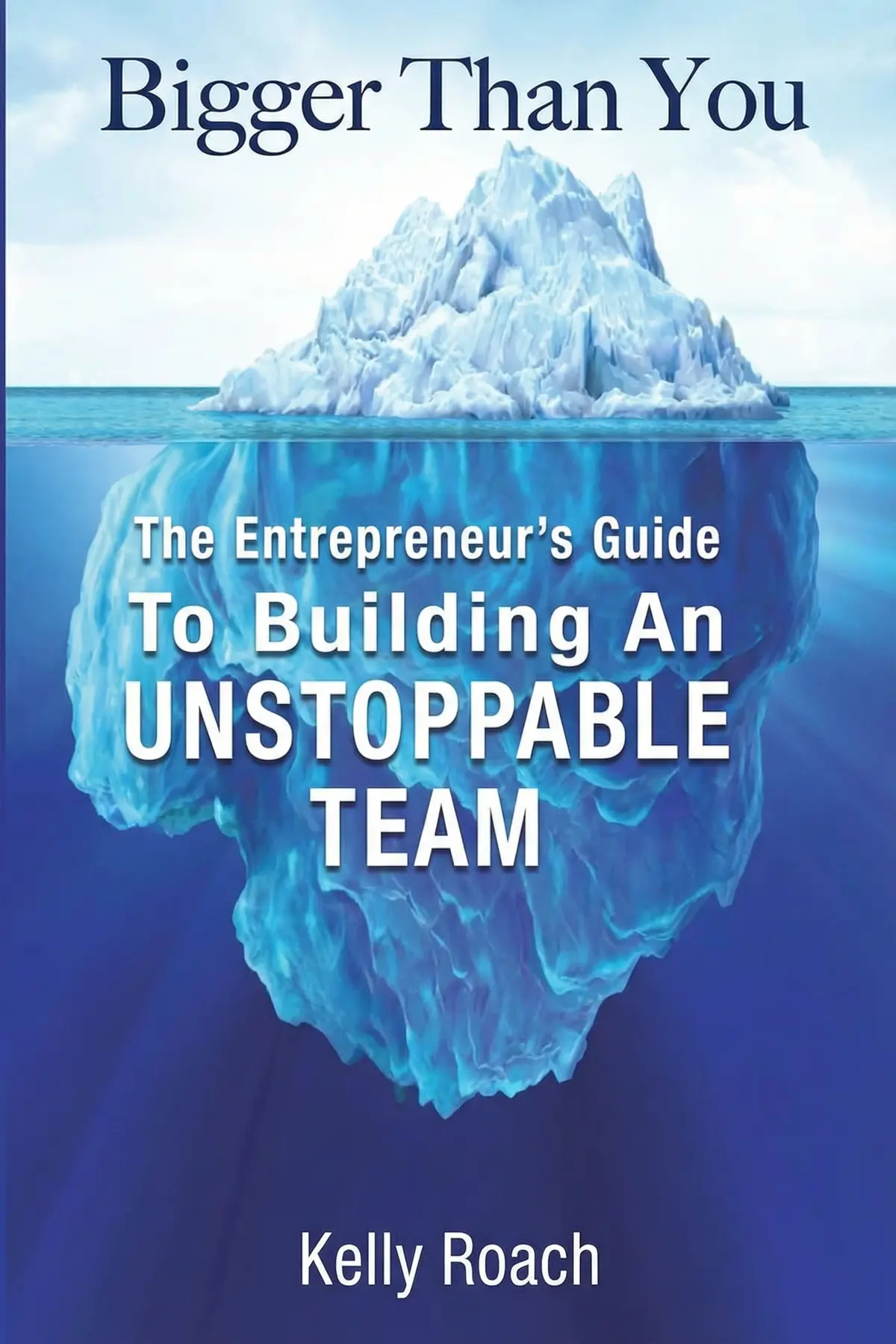
Table of Content
1. Introduction
56 sec
If you own a business, you may have started it for freedom and ended up as the person every decision waits on. In Bigger Than You, former Fortune 500 sales executive turned coach Kelly Roach traces that trap to one early mistake: treating a team as something you hire once the money comes in, when the team is what brings the money in. Growth, she argues, stands on two supports: a clear way of making sales and the right people working together.
Her case runs in a straight line. A business becomes bigger than its founder when the founder hires for character, writes down how the work is done, and gives every role a job that pays for itself. Roach builds it through a juice company that bought everything except a structure, a founder who rushed a hire without training and then let her go, and a factory owner who eased her cash problem with a simple form and new steps.
2. Build your team before the money arrives
1 min 40 sec
One founder spent $100,000 on equipment, software and marketing, and three years later had no customers at all. His mistake is common, and it rests on a belief about timing that most owners never question.
3. Hire for character and teach the skills
1 min 43 sec
A long list of experience looks like the safe choice in an interview. Roach built a business that runs while she is away with people who had very little of it, and she explains what she chose instead.
4. Stop new hires from failing before they start
1 min 58 sec
Hire someone, watch it go wrong, let them go, take the work back, burn out, repeat. Many capable founders live inside this loop for years, and the cause sits in what happens before the first day.
5. Make every role earn more than it costs
2 min 00 sec
Some owners run companies worth millions and still pay themselves like beginners. A factory owner who blamed her customers for a cash shortage found the real cause by asking one small word three times.
6. Clear systems that give your team room to think
1 min 58 sec
Many founders resist detailed procedures because they fear turning their company into a rigid machine. Roach points to a fast food chain and a jazz musician to argue that structure does something very different.
7. A business that keeps improving after you step back
1 min 49 sec
Roach once poured money into training her staff far beyond what their jobs needed, and the people around her thought she was wasting it. Years later, that bet explains why her company keeps pulling ahead.
8. Conclusion
1 min 07 sec
Roach turns the founder’s usual question around. Most owners ask how much more they can personally carry. She asks what would have to be true for the business to run on a day they never show up. Her answer runs through people and structure: a reliable sales process, staff chosen for their values, work written down before anyone is hired, and roles that each earn their keep. Charlie’s $100,000 bought everything except that, which is why it bought him nothing.
The practical moves are small enough to begin this week. Write down one process you still guard, from welcoming a client to sending an invoice, and include why each step matters. The next time cash runs short or a mistake keeps coming back, ask why three times before blaming customers or the market, the way Sandra found her missing invoice details. And in your next hire, weigh motivation and values at least as heavily as experience.
Freedom, in this account, is something you build into other people, one documented step at a time.
About this book
What is this book about?
Many owners start a business for freedom and end up working longer hours than ever, with every decision and every emergency waiting on them. Kelly Roach argues that this trap comes from how the business was built, and that the way out is a team strong enough to run without its founder. Through a handful of short cases and the story of her own company, Roach makes the case for building the team early, since the team is what grows the revenue. She explains why she hires for motivation and values over experience, why so many first hires fail when owners skip training and written processes, and how to judge every role by whether it brings in more than it costs. A juice company that spent $100,000 without finding customers, a founder caught in a cycle of hiring and firing, and a factory owner who fixed her cash flow with one form all show the principles at work. Readers get an order of operations for stepping back: who to hire, what to document before they start, how to measure each role, and how clear systems free people to improve the business on their own.
Book Information
Who it's for
Overworked small business owners
Small business owners who work every hour and feel like the bottleneck in their own company.
Founders with failing hires
Founders whose first hires keep failing and who want to break the hire, fire and burnout cycle.
Managers building self-running teams
Managers building a team that can run daily operations and improve them without supervision.
About the Author
Kelly Roach
Kelly Roach spent the first part of her career as a senior executive at a Fortune 500 company, where she generated more than $30 million in sales and was promoted seven times in eight years. A former National Football League cheerleader, she later founded Kelly Roach Coaching, which advises business owners, entrepreneurs and executives. Her teaching blends personal growth with sales, team building and business systems, and she is a bestselling author.
Ratings & Reviews
Ratings at a glance
What people think
Listeners find the book very easy to digest and believe it is essential reading for business owners. They also value its hands-on method for building teams, as one listener pointed out its ability to simplify leadership principles for everyday use. Furthermore, the work earns praise for its strategic insights, with one listener emphasizing how it facilitates the achievement of fast, long-term expansion.
Top reviews
Vimolwan
Finally got around to reading this guide on scaling, and it’s a total game-changer for anyone drowning in their own success. Roach makes a compelling case that your business shouldn’t depend entirely on your own sweat equity. I loved the breakdown of building a reliable sales process alongside a capable team; it's something I’ve neglected. While some sections feel a bit like a sales pitch for her coaching, the core principles of shifting from 'doer' to 'leader' are invaluable. It’s incredibly readable and provides that much-needed roadmap for achieving true entrepreneurial freedom. If you’re tired of putting out fires every single day, this is your sign to start documenting your systems. The focus on sustainable growth really resonated with me because I’ve been feeling the burnout lately. This isn't just theory; it’s a practical application of leadership concepts that you can use immediately.
Show moreSakura
After hearing so much buzz about this book, I decided to dive in to see if the hype was real. I appreciate how Roach emphasizes hiring based on values and character rather than just a resume full of technical skills. It's a refreshing take because most business books just tell you to hire 'the best,' which is usually code for 'the most expensive.' The story of Charlie and his juice company served as a sobering reminder of why foundational structures matter more than fancy equipment. Truth is, most of us are too scared to relinquish control, and this book gives you the permission to let go. It’s a solid read that I’ll likely revisit when I make my next big hire. Highly recommended for those ready to move toward a self-sustaining enterprise.
Show morePaiboon
As someone who has been stuck in the 'grind' for three years, this book felt like Kelly Roach was speaking directly to my soul. I’ve been the person working eighteen-hour days thinking I was 'crushing it' while my personal life fell apart. The roadmap provided here helps you reimagine your business as something that can actually function without your constant supervision. I especially liked the section on treating team roles as investments rather than just overhead costs. It’s a subtle mindset shift, but it changes everything about how you approach your budget and your growth strategy. The advice is practical, punchy, and devoid of the usual corporate fluff that ruins most business books. I’m already starting to map out my workflows to ensure my new hires have a recipe for success. This is a must-read for any solo founder looking to scale.
Show moreAdam
Wow, I didn't expect a business book to make me feel so seen, especially the part about Susan’s burnout. That story was a mirror for my own life, showing how hiring without proper preparation is just a recipe for disaster. Roach highlights that you can’t just throw people at a problem and expect it to go away without giving them the right tools. I’ve been guilty of 'hiring in a hurry' more times than I care to admit. This book taught me the importance of documenting every single step, from onboarding to payment processing. It’s a lot of work upfront, but the promise of a business that runs independently is too good to pass up. The focus on building a legacy really changed my perspective on what I’m actually building here. It’s not just about profit anymore; it’s about creating an entity that stands the test of time.
Show moreMonthon
The chapter on operational excellence alone is worth the price of admission for this book. Roach uses a great analogy about jazz musicians needing to master scales before they can truly improvise. It perfectly illustrates why we need rigid systems to actually achieve creative freedom in our businesses. I’ve always resisted structure because I thought it would stifle my team, but now I see it’s the exact opposite. By creating clear frameworks and teaching for understanding, I’m actually empowering my employees to take initiative. The book is written in a very straightforward, no-nonsense style that I really appreciated. Some might find the tone a bit aggressive, but I think that’s exactly what stressed-out business owners need to hear. It’s a quick read but one that requires you to actually stop and do the work. My team is already seeing the benefits of the new tracking metrics I’ve implemented.
Show moreTom
Picked this up on a whim during a particularly stressful week, and it was exactly what I needed to recalibrate. The author challenges the idea that you need to be financially 'ready' to hire, arguing instead that the right team is what creates that stability. It’s a scary thought for those of us who are risk-averse, but the logic is sound. Look, if you’re currently doing $10/hour tasks while trying to run a six-figure business, you are losing money every day. This book helps you identify those gaps and fill them with people who share your values. I’ve already started looking at my expenses through the lens of growth versus waste. Some of the anecdotes are a bit repetitive, but they drive the point home effectively. It’s a high-energy read that makes you want to get to work immediately. This is definitely a book for the doers.
Show moreHassan
Kelly Roach delivers a powerful framework for anyone ready to stop playing small and start building something extraordinary. This isn't just a book about hiring; it's a manifesto for visionary leadership and leaving a lasting legacy. I was particularly struck by the idea that every role should deliver more value than it costs. That one principle alone has completely changed how I plan to scale my marketing department next quarter. The writing is crisp, the advice is actionable, and the case studies provide a perfect blend of warning and inspiration. Sandra’s story about fixing cash flow through simple documentation was a highlight for me. It shows that often the biggest problems have the simplest solutions if you have the right systems in place. This book is a mandatory addition to any entrepreneur's library. It’s time to build something bigger than yourself.
Show moreIsabelle
To be fair, this is a very entry-level guide that focuses heavily on the 'why' rather than the intricate 'how.' If you are looking for a deep dive into HR law or complex financial modeling, you will be disappointed. However, as a foundational text for a new entrepreneur, it hits all the right notes. Roach has a knack for breaking down leadership concepts for daily application without making them feel overwhelming. I found the 'garden' analogy for business expenses particularly helpful for auditing my own monthly subscriptions. It’s a readable, fast-paced book that serves as a good kick in the pants for anyone who is currently 'the bottleneck' in their own company. I would have liked more specific templates for the systems she mentions. Still, it’s a solid resource for those just starting to build their first real team. It’s good, just not revolutionary.
Show moreTantipat
Ever wonder why some businesses seem to explode with growth while you’re stuck working harder than ever? This book answers that question by focusing on the power of a self-sustaining team. Kelly Roach explains that true freedom isn't just about making money; it's about having systems that allow you to step away. While I found the section on tracking performance a bit dry, the overall message about fostering a culture of innovation is spot on. I’ve struggled with delegation for years, mostly because I didn't trust anyone to do things 'my way.' Roach’s approach to documenting processes solves that trust issue by providing a clear recipe for everyone to follow. Not gonna lie, it’s a lot of writing to get those systems in place, but I can see the light at the end of the tunnel. It's a decent read, though a bit repetitive.
Show moreTak
Not what I expected given the glowing recommendations I’ve seen on social media. Frankly, the book feels more like an elaborate lead magnet for a coaching program than a standalone instructional manual. It’s only about 140 pages, and a lot of that is filled with basic common sense that any experienced manager already knows. If you’ve never led a team before, you might find some value here, but seasoned entrepreneurs will likely find it lacking in depth. The writing is accessible, which is a plus, but I was looking for more technical 'how-to' rather than just high-level philosophy. I wanted more meat on the bones regarding the actual documentation of processes. It’s not a terrible read by any means, but it certainly isn’t worth the premium price tag. There are better, more comprehensive guides out there for building a business legacy.
Show moreQuestions about this book
What is the main idea of Bigger Than You by Kelly Roach?
Roach argues that entrepreneurs stay trapped because they try to grow before building a team, when the team is what drives growth. Two things form the base of a business: a dependable method for generating sales, and a group of suitable people who collaborate. She recommends hiring for character, documenting processes before anyone starts, making every role return more than it costs, and using clear systems so the team can run and improve the business without the founder.
Why do new hires fail in small businesses, according to Kelly Roach?
Roach says owners treat hiring as a trade of money for work and skip the preparation a new person needs. In her example, Susan hired Tina in a rush, gave her only a task list, and then spent more time fixing errors than the work would have taken. After letting Tina go, everything came back at once. The fix is to write down processes and explain the reasons behind them before the hire arrives.
What does Kelly Roach look for when hiring?
She looks first at character: people who stay motivated, adapt easily and do the right thing. Her reasoning is that skills can be taught, but caring about the work and holding strong values cannot. Her own team members Stephanie, Nicole and Lindsay started with little experience, yet they take ownership of their roles and keep her business running smoothly when she is away.
How can I apply Bigger Than You in my business?
Start by documenting one task only you know how to do, including why each step matters, and teach it. Review your spending and roles, asking whether each one brings in more than it costs. When a problem repeats, ask why three times, as Sandra did to trace her cash shortage to late invoices. Give each role clear numbers that show its contribution, and invest in skills your team will need later.
Readers also enjoyed


A Bigger Prize: How We Can Do Better Than the Competition
Margaret Heffernan





A Year with Peter Drucker: 52 Weeks of Coaching for Leadership Effectiveness
Joseph A. Maciariello


AUDIO SUMMARY AVAILABLE
Listen to Bigger Than You in 15 minutes
Get the key ideas from Bigger Than You by Kelly Roach, plus 5,000+ more nonfiction titles.
- 5,000+ titles
- Listen as much as you want
- 7-day free trial
- Cancel anytime









